Range Map
• nm at current load
• click map to move • two fingers to move map
Payload vs. Range
Fuel on board
Extra weight
nm
Range
Mission Profile
- High-Performance
- Complex
- High-Altitude
- Pressurization
- Multi-Engine
_(8-5-2022).jpg)
Estimated Ownership Costs
Create a free account to view or request ownership cost data.
About the Piper PA-31P Pressurized Navajo
Type certificated 1969 Source: FAA Type Certificate Data Sheet
Overview
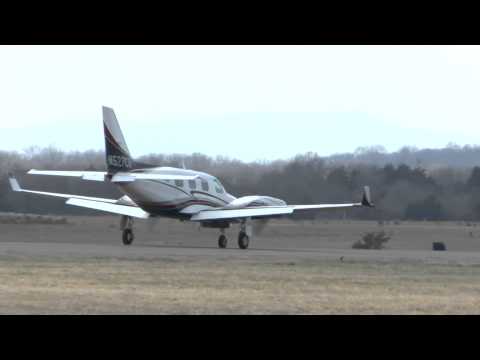
The Piper PA-31P Pressurized Navajo is a cabin-class, twin-engine pressurised piston aircraft and Piper’s first pressurised airplane, certificated under FAA Type Certificate A8EA and produced from 1970 to 1977. Roughly 259 airframes left the Lock Haven factory before the program was discontinued, making the P-Navajo one of the rarest large pistons in the modern used market.
Development began in January 1966 with a clear competitive target: deliver a pressurised cabin twin that could rival the Cessna 421 and Beech Duke at corporate altitudes while preserving the airstair, club-seating layout that the unpressurised PA-31 Navajo had popularized with charter operators. To get there, Piper specified the geared, turbocharged, fuel-injected Lycoming TIGO-541-E1A, rated at 425 hp per side at 20,000 ft, swinging 93.5 inch Hartzell three-blade feathering propellers. The resulting 850 hp total powerplant gave the P-Navajo a 1,740 fpm sea-level best rate of climb and the structural margin for a 7,800 lb MTOW pressurised hull.
The pressurisation system runs a 5.5 psi differential, the same value Piper would later carry forward to the Malibu and the PA-31T Cheyenne. That differential keeps a 5,000 ft cabin at FL200 and a 10,000 ft cabin at FL280, which is the operating altitude that justifies the airplane’s complexity. Cruise at high cabin altitudes returns 220 KIAS, equivalent to roughly 231 KTAS at FL200, with a still-air range with reserves of about 1,160 nm.
The trade-off was the TIGO-541 itself. The geared 540-series Lycoming proved fragile in service, originally certificated with an 800 hr TBO (later raised to 1,200 hr) and an overhaul cost that aviation media of the era flagged as the highest in the piston twin market. Production ended in 1977; in 1984 Piper attempted a redesign with the PA-31P-350 Mojave, which kept the P-Navajo’s pressurised fuselage architecture but substituted the cheaper, more durable 350 hp TIO-540-V2AD. The P-Navajo is a hard airplane to recommend casually: its geared TIGO-541 engines carry a 1,200-hour TBO that field experience shows they often fail to reach, and overhaul and parts costs scale with the type’s scarcity. The buyer who can carry that burden, and who genuinely needs a pressurised club-cabin twin able to hold a 10,000-foot cabin in the high flight levels, is the narrow audience it was built for.
Key Features for GA Buyers
- True Cabin-Class Pressurisation. 5.5 psi differential maintains a 5,000 ft cabin at FL200 and a 10,000 ft cabin at FL280, putting weather, ice, and most piston-twin terrain below the airplane. Few piston twins ever offered this level of high-altitude comfort.
- Climb and High-Altitude Performance. 425 hp per side and a 9.1 lb/hp power loading deliver a 1,740 fpm sea-level best rate and a 29,000 ft service ceiling, both exceptional for a piston twin and competitive with light turboprops of the era.
- Cabin Layout. Six club-style passenger seats, a one-piece airstair entry door, and a roughly 50 in by 50 in cabin cross-section give the P-Navajo cabin volume and a club-class layout uncommon among owner-flown twins of its era.
- Range. 236 gallon usable fuel capacity (including the 25 gallon nacelle aux tanks) yields a roughly 1,160 nm range with IFR reserves, supporting non-stop legs between most US business-aviation city pairs.
- Rarity and Type Support. With only 259 airframes built and a recognizable longer-nose silhouette, the P-Navajo is uncommon on the ramp; type-club support survives through the Piper Owner Society and a small specialist maintenance community.
Trade-offs
- TIGO-541 Engine Cost and Fragility. The geared, turbocharged TIGO-541-E1A carries the shortest TBO of any modern piston twin engine (1,200 hr) and overhaul costs widely cited as the highest in the class. Aviation Consumer documented field failures at TBO and shortly thereafter as common, and recommends the type only for buyers committed to its specific maintenance ecosystem.
- Range Limited by Fuel Burn. Combined cruise fuel burn in the mid 40s GPH constrains practical IFR endurance to roughly three hours; the optional 54 gallon supplemental fuel system addresses this but is not universally installed.
- Parts Scarcity. With 259 airframes built and production ended in 1977, model-specific airframe components (pressure bulkhead seals, nacelle baffling, propeller gearbox spares) can be slow to source. Maintenance is concentrated in a small number of type-experienced shops.
- Resale Discount. The PA-31P typically trades at a discount to comparable unpressurised PA-31 Chieftains and to the Cessna 421 on a per-airframe basis, reflecting market awareness of the TIGO-541 cost profile rather than the airplane’s underlying capability.
- Insurance and Training. A pressurised, geared-engine twin sits in the highest pilot-experience and recurrent-training bracket for piston insurance; expect strict total-time, multi-engine, and type-specific training requirements.
See Also
- Piper PA-31P-350 Mojave – Direct successor in the PA-31 pressurised family; lower-cost airframe with the cheaper TIO-540 piston pair. Compare
- Cessna 421C Golden Eagle – Period rival from Wichita and the dominant pressurised piston twin of the same era. Compare
- Beechcraft Duke 60 – Beechcraft entry in the pressurised piston twin bracket; smaller cabin, similar speed and ceiling. Compare
- Piper PA-31 Navajo – Unpressurised base PA-31 Navajo from which the airframe was derived. Compare
- Rockwell Commander 685 – Direct period competitor; GTSIO-520-powered pressurised piston cabin twin in the same 9,000 lb class. Compare
Technical Specifications
Dimensions & Weights
- Height
- 13 ft
- Length
- 34 ft
- Parking area (ft²2)
- 1,997 ft²
- Max Takeoff Weight
- 7,800 lbs
- Max Landing Weight
- 7,500 lbs
- Useful Load
- 2,756 lbs
- Fuel Capacity
- 236 gal
Performance
- Cruise Speed
- 231 KTAS
- Never-Exceed (VNE)
- Source: FAA Type Certificate Data Sheet 246 KIAS
- Max Structural Cruise (VNO)
- Source: FAA Type Certificate Data Sheet 200 KIAS
- Approach Speed
- 95 KIAS
- Stall, Clean (VS1)
- 73 KIAS
- Range
- 1160 NM
- Service Ceiling
- 29,000 ft
- Rate of Climb
- 240 - 1740 fpm
- Takeoff over 50 ft obstacle
- 2,200 ft
- Landing ground roll
- 1,370 ft
Engines
Log in to view or request powerplant data.
Sources
Where the figures on this page come from. Piper PA-31P Pressurized Navajo specifications are traced to published references; estimated values are flagged inline next to the figure.
Similar to the Piper PA-31P Pressurized Navajo
Similar PistonsPiper PA-31P-350 Mojave
Cessna 340
Aero Commander 680FP
Rockwell Commander 685
Piper Navajo PA-31
Beechcraft Duke 60
Cessna 414A Chancellor
Cessna 421C Golden Eagle
Piper Aero Star
Compare the Piper PA-31P Pressurized Navajo to other aircraft