Range Map
• nm at current load
• click map to move • two fingers to move map
Payload vs. Range
gal
Fuel on board
lbs
Extra weight
nm
Range
Mission Profile
- High-Performance
- Complex
- High-Altitude
- Pressurization
- Multi-Engine
Estimated Ownership Costs
Create a free account to view or request ownership cost data.
About the Beechcraft Duke 60
Type certificated 1973 Source: FAA Type Certificate Data Sheet
Overview
The Beechcraft Duke 60 is a pressurized, six-seat piston twin built from 1968 to 1983, positioned in the Beechcraft line between the Baron and the cabin-class Queen Air. This record reflects the B60, the final and most-produced variant (1974-1983): two 380-horsepower Lycoming TIO-541-E1C4 turbocharged engines, a 6,775-pound maximum takeoff weight, a 30,000-foot operating ceiling, and a club-seated cabin entered through a port-side airstair door. It cruises near 200 knots in the low flight levels behind a distinctive airstair-entry pressurized airframe, and its low-production, scarce-parts turbocharged TIO-541 engines make it costly to keep.
The Duke’s natural rival is the pressurized Cessna 340, a cabin-class twin offering similar pressurized comfort. Owners also cross-shop the unpressurized Beechcraft Baron 58 for buyers who can trade the sealed cabin for cheaper Continental engines, the larger Cessna 414 Chancellor for more cabin, and the single-engine pressurized Piper M350 for buyers weighing one turbine-smooth engine against two thirsty pistons. Choose the Duke when its speed, ramp presence, and pressurized cabin matter more than running cost, and you have budgeted honestly for the engines.
Key Features for GA Buyers
- Pressurized cabin to 30,000 feet. A roughly 4.6 psi differential holds a comfortable cabin altitude in the high teens and low flight levels, above much of the weather that grounds unpressurized twins.
- 380-horsepower turbocharged power. Two Lycoming TIO-541-E1C4 engines sustain cruise speeds near 200 knots well into the flight levels, making the Duke genuinely fast for a piston twin.
- Cabin-class presence. The port-side airstair door, club seating, and bonded-honeycomb fuselage give the Duke a small-airliner feel that the Baron and most light twins cannot match.
Trade-offs
- The engines define the cost of ownership. The Lycoming TIO-541 is a low-production, geared-era turbocharged engine; parts are scarce and largely quote-gated, specialist shops are few, and a firewall-forward overhaul of both engines runs well into six figures. The Duke is cheap to buy and expensive to keep, and a low-time, recently-overhauled example is worth a substantial premium over a run-out one.
- Full fuel versus payload. Standard wing fuel is 142 usable gallons; optional tip and nacelle tanks extend that to 232 gallons and the range past 1,200 nautical miles, but filling them leaves little cabin payload.
- Systems complexity. Pressurization, two turbocharger systems, and known-ice equipment raise maintenance and recurrent-training demands well above an unpressurized light twin.
- Endorsements and insurance. High-performance, complex, high-altitude, pressurization, and multi-engine endorsements all apply, and underwriters price the type accordingly, especially for lower-time pilots.
See Also
- Cessna 340 – the pressurized cabin-class Cessna twin and the Duke’s closest period rival. Compare
- Beechcraft Baron 58 – the unpressurized Beechcraft six-seat twin with cheaper Continental engines. Compare
- Cessna 414 Chancellor – the larger pressurized Cessna cabin twin for buyers who want more room. Compare
- Piper M350 – the pressurized single-engine alternative for owners weighing one engine against two. Compare
Technical Specifications
Dimensions & Weights
- Height
- 12.33 ft
- Length
- 33.83 ft
- Parking area (ft2)
- 1914.32 ft2
- Max Takeoff Weight
- Source: FAA Type Certificate Data Sheet 6,775 lbs
- Max Landing Weight
- 6,775 lbs
- Useful Load
- 2,500 lbs
- Fuel Capacity
- Source: FAA Type Certificate Data Sheet 142 gal
Performance
- Cruise Speed
- 201 KTAS
- Never-Exceed (VNE)
- Source: FAA Type Certificate Data Sheet 233 KIAS
- Max Structural Cruise (VNO)
- Source: FAA Type Certificate Data Sheet 207 KIAS
- Approach Speed
- 98 KIAS
- Range
- 714 NM
- Service Ceiling
- 30,000 ft
- Rate of Climb
- 1601 fpm
Engines
Log in to view or request powerplant data.
Sources
Where the figures on this page come from. Beechcraft Duke 60 specifications are traced to published references; estimated values are flagged inline next to the figure.
Similar to the Beechcraft Duke 60
Similar PistonsAero Commander 500
Aero Commander 500A
Aero Commander 560
See how the Beechcraft Duke 60 stacks up against similar aircraft
External Media
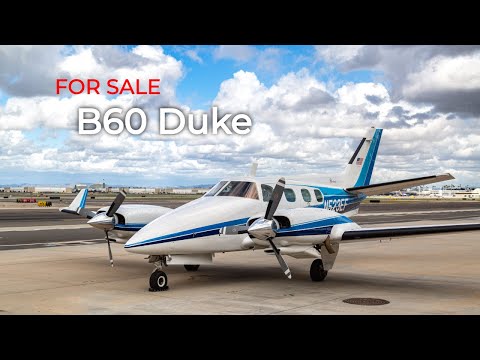
Image Galleries
Articles and other links
-
Beechcraft Duke - Wikipedia en.wikipedia.org
-
Quick Look: Put Up Your Dukes - AOPA www.aopa.org
-
Beech Duke - Aviation Consumer aviationconsumer.com
-
DUKE B60 Specifications, Performance, and Range - Globalair.com www.globalair.com
-
History of the Beechcraft Duke - Duke Flyers Association www.dukeflyers.org