Range Map
• nm at current load
• click map to move • two fingers to move map
Payload vs. Range
gal
Fuel on board
lbs
Extra weight
nm
Range
Mission Profile
- High-Performance
- Complex
- Multi-Engine
Estimated Ownership Costs
Create a free account to view or request ownership cost data.
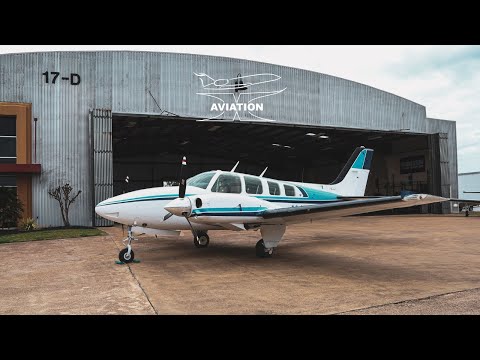
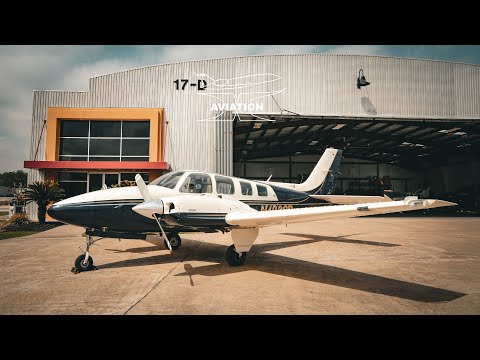
About the Beechcraft Baron 58
Type certificated 1969 Source: FAA Type Certificate Data Sheet
Overview
The Beechcraft Baron 58 is the stretched, six-seat development of the Baron 55 and the airplane most buyers mean by “Baron.” Introduced in 1969 with a fuselage roughly 10 inches longer than the 55, it adds true club seating and a pair of aft right-side doors that make cabin and cargo loading far easier than the 55 or most competing light twins. The line remains in production today as the G58 with the Garmin G1000 NXi flight deck. This record reflects the 300-horsepower configuration: two Continental IO-550-C engines, a 5,500-pound maximum takeoff weight, and about 202 knots cruise. Model 58s built before 1984 carried the 285-horsepower Continental IO-520-C at a 5,400-pound gross, and that earlier engine covers the larger share of the used fleet, so a pre-1984 58 is the lower-powered airplane.
It is the twin step up from the Beechcraft Bonanza A36, with which it shares much of its structure and handling. Owners cross-shop it against the Cessna 310 as the contemporary Cessna light twin, the pressurized Cessna 340 for buyers who want a sealed cabin, and the shorter-body Beechcraft Baron 55 for those who do not need the larger cabin or cargo doors. Choose the 58 when you want a longer cabin and easier cargo loading than the 55 provides, with current-production parts support.
Key Features for GA Buyers
- Club cabin and aft double doors. The 10-inch stretch and the right-side double doors give the 58 genuine six-place club seating and load access that the 55 and most light twins cannot match.
- 300-horsepower IO-550-C power. Two fuel-injected Continentals on a 1,700-hour TBO drive a cruise of about 202 knots, with single-engine performance competitive for the class.
- Beech handling. The 58 carries the light, well-harmonized control feel of the Bonanza line into a twin, which makes it a stable and pleasant IFR platform.
- Current-production support. The Model 58 is still built as the G58, so parts, service expertise, and type knowledge are unusually deep across the fleet.
Trade-offs
- Full fuel versus payload. With the optional long-range tanks filled to 194 gallons, the cabin is often limited to a pilot and one or two passengers; a full-house mission requires carrying less fuel.
- Cabin width. At about 42 inches the cabin is narrower than the Piper Seneca, which can feel tight for larger front-seat occupants.
- Two-engine operating cost. Two 300-horsepower Continentals and a retractable gear system cost more to run than a high-performance single, and the combined fuel burn is near 31 gallons per hour.
- Endorsements and insurance. High-performance, complex, and multi-engine endorsements all apply, and underwriters price low-multi-time pilots well above experienced ones.
See Also
- Beechcraft Baron 55 – the shorter-fuselage Baron without the club cabin or cargo doors, for a lower entry cost. Compare
- Cessna 310 – the contemporary Cessna light twin with wing-tip-tank fuel and comparable speed. Compare
- Cessna 340 – the pressurized cabin-class Cessna twin for buyers who want a sealed cabin in the flight levels. Compare
- Beechcraft Bonanza A36 – the six-seat single that shares the 58’s cabin and DNA, for buyers weighing one engine against two. Compare
Base model
Beechcraft 95 Travel AirTechnical Specifications
Dimensions & Weights
- Height
- 9.75 ft
- Length
- 29.83 ft
- Parking area (ft2)
- 1665.92 ft2
- Max Takeoff Weight
- Source: FAA Type Certificate Data Sheet 5,500 lbs
- Max Landing Weight
- 5,400 lbs
- Useful Load
- 1,500 lbs
- Fuel Capacity
- Source: FAA Type Certificate Data Sheet 136 gal
Performance
- Cruise Speed
- 202 KTAS
- Never-Exceed (VNE)
- Source: FAA Type Certificate Data Sheet 223 KIAS
- Max Structural Cruise (VNO)
- Source: FAA Type Certificate Data Sheet 195 KIAS
- Approach Speed
- 95 KIAS
- Stall, Clean (VS1)
- 84 KIAS
- Range
- 885 NM
- Service Ceiling
- 20,688 ft
- Rate of Climb
- 1735 fpm
- Takeoff over 50 ft obstacle
- 2,345 ft
- Landing ground roll
- 2,490 ft
Engines
Log in to view or request powerplant data.
Sources
Where the figures on this page come from. Beechcraft Baron 58 specifications are traced to published references; estimated values are flagged inline next to the figure.
Similar to the Beechcraft Baron 58
Similar PistonsAero Commander 500
Aero Commander 500A
Aero Commander 560
See how the Beechcraft Baron 58 stacks up against similar aircraft