Range Map
Origin: → · two fingers to move map
Payload vs. Range
Fuel on board
Cargo
nm
Range
Trip Preview
Name a destination in the map header above and this becomes your trip: time en route, what you burn, what it costs, and whether you get there without stopping — at the load you have set.
→
Over max payload by . At this load it cannot lift a single occupant. Please adjust your payload inputs.
We do not have a cruise speed on file for this aircraft, so there is no honest time or cost to give you for this leg.
En route
Fuel burned
Direct cost
Fuel cost
Tanks run dry about past before at this burn.
Mission Profile
- High-Performance
- Complex
- Multi-Engine
_(4-10-2024).jpg)
Estimated Ownership Costs
Create a free account to view or request ownership cost data.
About the Aero Commander 500
Type certificated 1958 Source: FAA Type Certificate Data Sheet
Overview
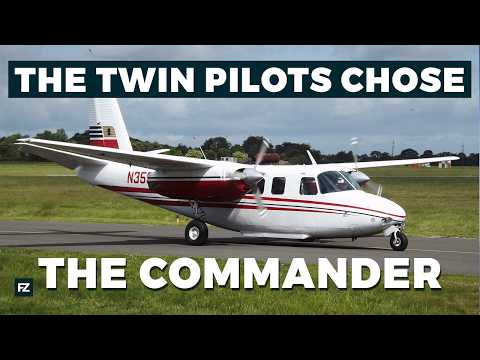
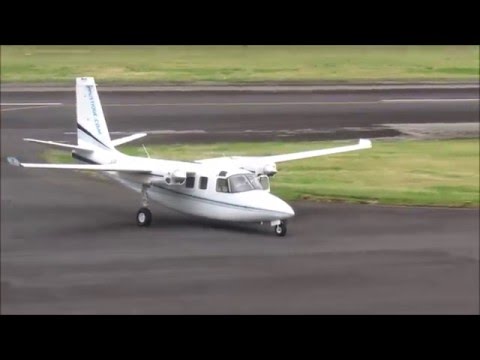
The Aero Commander 500 is a high-wing, twin piston cabin-class utility aircraft introduced in 1958 as the base member of the Aero Design and Engineering Commander twin family. Built around two 250 hp Lycoming O-540-A2B engines, it carries up to seven occupants (one pilot plus six passengers) in an unpressurised cabin sitting forward of the wing, with retractable tricycle landing gear and 156 gallons of usable fuel.
Production of the original Model 500 ran from 1958 to roughly 1960, with about 101 airframes built before the line evolved into the 500A (1960, Continental IO-470-M, 260 hp), the 500B (1966, Lycoming IO-540, 290 hp), and ultimately the 500S Shrike. All shared the same 49 ft wing and overall planform; the base 500 is the original and lowest-powered variant of the cluster, certified on July 24, 1958 under FAA Type Certificate 6A1.
The airframe’s signature feature is the wing carry-through structure passing above the cabin, which leaves a flat, unobstructed cabin floor and exceptional sightlines, traits that drove its later reputation as a steady camera and survey platform. Bob Hoover’s well-known airshow routine in the Shrike Commander (the same airframe family, late variant) is the model’s most visible legacy.
Key Features for GA Buyers
- Cabin-class twin layout. Stand-up cabin volume (177 cu ft, roughly 10.6 ft long by 4.3 ft wide by 4.4 ft tall), club seating for up to seven, and a flat floor uncommon in light twins of the era, courtesy of the over-cabin wing carry-through.
- Honest twin-piston redundancy. Two carbureted Lycoming O-540-A2B engines rated 250 hp at 2575 rpm, 156 gallons usable fuel, and a 22,500 ft service ceiling deliver real over-the-weather and over-water capability for owner-pilots stepping up from a single.
- Roomy useful load. Roughly 2,150 lb useful load against a 6,000 lb gross gives genuine four-to-five-adult plus baggage utility with reasonable fuel.
- Stable, forgiving handling. High-wing geometry and conservative wing loading give predictable slow-flight manners; the type is widely considered docile for a cabin-class twin.
- Type-certificate continuity. Twin Commander Aircraft LLC continues to support the line under TC 6A1, which keeps parts, manuals, and approved-supplier paths reachable for a 1950s-era airframe.
Trade-offs
- Real-world cruise lags the book. Manufacturer normal cruise is 199 mph / 172.5 kts at 70 percent power at 10,000 ft per Twin Commander LLC; owner-reported real-world cruise from the 250 hp small-engine 500 typically falls in the 150 to 155 kt range, per Aviation Consumer and AVweb.
- Underpowered relative to its cabin. At 250 hp per side it carries the same 6,000 lb gross as later 290 hp variants did at 6,750 lb, so single-engine climb and hot-and-high performance are notably weaker than on the 500B or Shrike.
- Fuel burn for the speed. Combined burn of roughly 27 to 30 gph against a 150 to 155 kt cruise yields specific range that compares unfavorably with newer light twins like the Baron 55 or the 1960s-era Aztec.
- Age-related ownership cost. The youngest base 500s are early-1960s airframes, so corrosion inspection, wiring, hoses, and avionics modernisation should all be assumed costs at acquisition.
- Unpressurised, modest useful cruise altitudes. A 22,500 ft service ceiling looks generous on paper, but useful cruise altitudes with passengers are far lower; expect to operate in the lower flight levels with supplemental oxygen for any sustained altitude work.
- High-performance endorsement required. Each Lycoming O-540-A2B produces 250 hp, so under FAR 61.31(f) the type requires a high-performance airplane endorsement in addition to the multi-engine rating.
- Variant confusion in market data. Listings and broker spec sheets routinely conflate 500, 500A, 500B, and 500S figures; verify the specific model and engine fitment on any candidate airframe before relying on published performance numbers.
See Also
- Aero Commander 500A – Immediate successor variant; 260 hp Continental IO-470-M fuel-injected engines on the same airframe, the natural step-up within the family. Compare
- Piper Aztec – Direct period competitor; same-era light cabin-class twin piston with a lower acquisition cost. Compare
- Cessna 310 – Direct period competitor; sleeker low-wing twin with comparable seating and higher cruise. Compare
- Beechcraft 50 Twin Bonanza – Same-class 1950s cabin-class twin; common cross-shop for buyers weighing a high-wing versus low-wing alternative. Compare
- Beechcraft Baron 55 – Successor-generation upgrade path; faster, more modern light cabin twin that displaced much of the 500 family in the used market. Compare
Technical Specifications
Dimensions & Weights
- Height
- 14 ft
- Length
- 35 ft
- Parking area (ft²2)
- 2,368 ft²
- Max Takeoff Weight
- 6,000 lbs
- Max Landing Weight
- 6,000 lbs
- Useful Load
- 2,150 lbs
- Fuel Capacity
- 156 gal
Performance
- Cruise Speed
- Source: manufacturer figure 173 KTAS
- Never-Exceed (VNE)
- Source: FAA Type Certificate Data Sheet 234 KIAS
- Max Structural Cruise (VNO)
- Source: FAA Type Certificate Data Sheet 182 KIAS
- Approach Speed
- 71 KIAS
- Stall, Clean (VS1)
- 63 KIAS
- Range
- 955 NM
- Service Ceiling
- 22,500 ft
- Rate of Climb
- 1400 fpm
- Takeoff over 50 ft obstacle
- 1,250 ft
- Landing over 50 ft obstacle
- 1,350 ft
Engines
Log in to view or request powerplant data.
Sources
Where the figures on this page come from. Aero Commander 500 specifications are traced to published references; estimated values are flagged inline next to the figure.
Similar to the Aero Commander 500
Similar PistonsAero Commander 500A
Aero Commander 560
Piper Aztec
Cessna 303 Crusader
Cessna 320 Skyknight
Beechcraft Baron 58
Cessna 310
Piper PA-34 Seneca
Beechcraft Baron 55
Beechcraft Twin Bonanza
Compare the Aero Commander 500 to other aircraft
External Media
Articles and other links
-
Aero Commander 500 family en.wikipedia.org
-
Twin Commander Model 500 www.twincommander.com
-
Twin Commander Model 500 TCDS 6A1 (Rev 48) rgl.faa.gov
-
Twin Commander 500 — Used Aircraft Guide aviationconsumer.com
-
Twin Commander 500 Shrike avweb.com
-
Rockwell Commander Shrike (Aero Commander 500) www.planeandpilotmag.com
-
1958-1959 Commander 500 Specifications & Operating Cost (PlanePhD) planephd.com