Range Map
Origin: → · two fingers to move map
Payload vs. Range
Fuel on board
Cargo
nm
Range
Trip Preview
Name a destination in the map header above and this becomes your trip: time en route, what you burn, what it costs, and whether you get there without stopping — at the load you have set.
→
Over max payload by . At this load it cannot lift a single occupant. Please adjust your payload inputs.
We do not have a cruise speed on file for this aircraft, so there is no honest time or cost to give you for this leg.
En route
Fuel burned
Direct cost
Fuel cost
Tanks run dry about past before at this burn.
Mission Profile
- High-Performance
- Complex
- Multi-Engine
 (4-9-2024).jpg)
Estimated Ownership Costs
Create a free account to view or request ownership cost data.
About the Cessna 310
Type certificated 1975
Overview
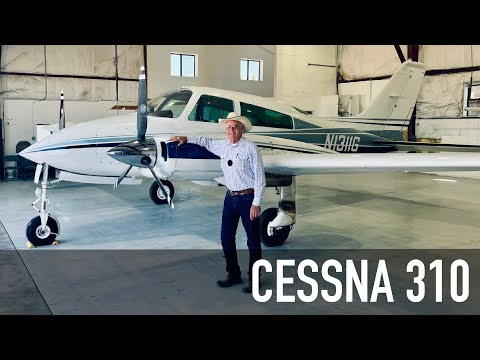
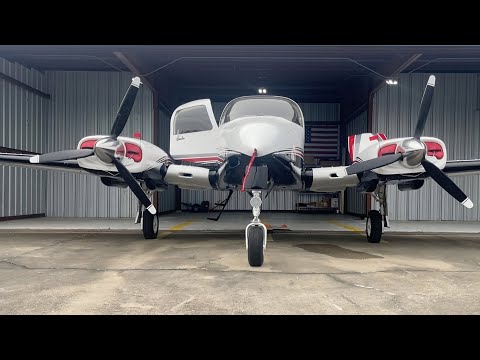
The Cessna 310 is a six-seat light piston twin, the type that defined Cessna’s twin-engine line for two decades. This record covers the final 310R, built from 1975 to 1981, with a lengthened nose that adds a dedicated baggage compartment ahead of the cabin. Two fuel-injected Continental IO-520-M engines of 285 horsepower each drive constant-speed propellers, and the distinctive wing-tip fuel tanks carry the standard 102 usable gallons. Maximum takeoff weight is 5,500 pounds against a useful load of roughly 2,080 pounds, and the airplane cruises near 195 knots true at 75 percent power.
The 310 suits a buyer who wants genuine six-seat cross-country speed and 1970s ramp presence, and who can absorb the running cost of two large-displacement Continentals. Combined fuel burn is about 31 gallons per hour at 75 percent cruise, and the catalogue models direct operating cost near $352 per hour. The wing-tip tanks concentrate fuel mass outboard, which keeps the airframe steady in cruise but demands disciplined energy management in the flare, so the 310 rewards a pilot willing to stay current rather than one looking for a forgiving first twin.
Key Features for GA Buyers
- Six-seat cabin with nose baggage. The R-model’s lengthened nose adds a dedicated forward baggage compartment ahead of the cabin and wing-locker storage.
- Roughly 195-knot cruise. At 75 percent power the 310R returns about 195 knots true, genuine cross-country speed for a piston twin.
- Continental IO-520-M power. 285 horsepower per side with a 1,700-hour published TBO, supported across the Continental overhaul network.
- Wing-tip fuel tanks. The standard 102 usable gallons sits in the tip tanks, a defining feature of the type, with optional auxiliary and wing-locker tanks on many airframes for extended range.
Trade-offs
- Two large piston engines to feed and overhaul. Combined burn near 31 gph at 75 percent cruise and a pair of IO-520s on a 1,700-hour TBO put running cost well above a high-performance single.
- Demanding near the runway. The outboard tip-tank fuel mass gives sluggish roll response in the landing configuration, and inattentive flare technique can set up wing-rocking that catches out low-time multi pilots.
- Fuel-system management. Mains, optional auxiliaries, and wing-locker tanks each carry their own crossfeed rules and unusable-fuel limits, so transitioning pilots need recurrent training.
- Unpressurised, non-turbocharged. True airspeed and useful load fall off above roughly 12,000 feet; the turbocharged T310R addresses that but is a separate maintenance and acquisition conversation.
- Multi-engine insurance step-up. Underwriter minimums for a six-seat twin run well above those for a single, and low-time multi pilots face higher quotes than experienced ones.
See Also
- Piper Aztec – contemporary Piper six-place piston twin and direct competitor. Compare
- Beechcraft Baron 58 – Beechcraft’s six-place piston twin with comparable speed and a different handling character. Compare
- Piper PA-34 Seneca – Piper’s lighter, more economical twin in the same class. Compare
- Cessna 340 – Cessna’s pressurised step up from the 310 on a similar ramp footprint. Compare
- Piper Navajo – cabin-class step up from the six-place light twins. Compare
Featured in our buying guides
Technical Specifications
Dimensions & Weights
- Height
- 11 ft
- Length
- 32 ft
- Parking area (ft²2)
- 1,730 ft²
- Max Takeoff Weight
- 5,500 lbs
- Max Landing Weight
- 5,400 lbs
- Useful Load
- 2,083 lbs
- Fuel Capacity
- 102 gal
Performance
- Cruise Speed
- 195 KTAS
- Never-Exceed (VNE)
- Source: third-party reference 223 KIAS
- Max Structural Cruise (VNO)
- Source: third-party reference 181 KIAS
- Approach Speed
- 93 KIAS
- Stall, Clean (VS1)
- 79 KIAS
- Range
- 661 NM
- Service Ceiling
- 19,750 ft
- Rate of Climb
- 370 - 1662 fpm
- Takeoff over 50 ft obstacle
- 1,700 ft
- Landing over 50 ft obstacle
- 1,790 ft
Engines
Log in to view or request powerplant data.
Sources
Where the figures on this page come from. Cessna 310 specifications are traced to published references; estimated values are flagged inline next to the figure.
Similar to the Cessna 310
Similar PistonsPiper Aztec
Cessna 320 Skyknight
Piper PA-34 Seneca
Cessna 303 Crusader
Beechcraft Baron 58
Beechcraft Baron 55
Aero Commander 500
Aero Commander 500A
Cessna 337 Skymaster
Aero Commander 560
Piper Aero Star
Compare the Cessna 310 to other aircraft