Range Map
Origin: → · two fingers to move map
Payload vs. Range
Fuel on board
Cargo
nm
Range
Trip Preview
Name a destination in the map header above and this becomes your trip: time en route, what you burn, what it costs, and whether you get there without stopping — at the load you have set.
→
Over max payload by . At this load it cannot lift a single occupant. Please adjust your payload inputs.
We do not have a cruise speed on file for this aircraft, so there is no honest time or cost to give you for this leg.
En route
Fuel burned
Direct cost
Fuel cost
Tanks run dry about past before at this burn.
Mission Profile
- High-Performance
- Complex
- Pressurization
_(3-18-2023).jpg)
Estimated Ownership Costs
Create a free account to view or request ownership cost data.
About the Piper M350
Type certificated 1988
Overview
The Piper M350 is the direct descendant of the PA-46 Malibu Mirage and occupies a unique position in general aviation: it is the only pressurised single-engine piston aircraft currently in production. That distinction matters. Pressurisation at the piston level has historically been a difficult engineering problem, and the PA-46 airframe, refined across four decades, remains the only current answer to it.
Powered by a turbocharged Lycoming TIO-540-AE2A producing 350 HP, the M350 cruises at 213 knots at altitudes up to FL250 while holding an 8,000-ft cabin equivalent throughout, and the current production variant pairs the Garmin G1000 NXi suite with active safety systems unavailable on earlier Mirage models. It sits at the entry of Piper’s M-class line, below the turboprop M500, for the buyer who wants cabin-class comfort and genuine weather capability on a piston fuel bill. That positioning points the M350 at the buyer flying two adults and bags on trips under 800 NM who wants those qualities without a turbine’s fuel bill. Anyone who needs turbine speed, flight-level climb, or PT6A dispatch simplicity should start one rung up, at the M500.
Key Features for GA Buyers
-
Pressurisation at the Piston Level. The 5.5 psi differential pressurisation system maintains an 8,000-ft cabin at FL250. This is the M350’s defining characteristic: the ability to operate above most convective weather and turbulence without supplemental oxygen, in an aircraft with piston operating economics.
-
Advanced Safety Suite. The G1000 NXi integration includes Pulse Oximetry monitoring, Hypoxia Recognition with Automatic Descent Mode, and Electronic Stability Protection. These are substantive pilot-incapacitation mitigations that meaningfully change the risk profile of single-pilot IFR operations.
-
Cabin-Class Utility. The PA-46 cabin offers airstair door entry, club seating for four passengers, and stand-up headroom adequate for most occupants. For a single-engine piston, the interior environment is genuinely competitive with light twins.
-
Piston Operating Economics. At 21 GPH, the M350 burns roughly 40% less fuel per hour than the turboprop M500. For owners flying 150 to 200 hours per year on missions under 800 NM, the fuel cost differential is substantial over an ownership period.
Trade-offs
- Systems Complexity. Pressurisation, turbocharging, FIKI, and retractable gear in combination require disciplined maintenance. Annual inspection costs reflect this: budget $5,000 to $8,000 as a base, with unscheduled items on top.
- Useful Load vs. Full Fuel. 120 gallons (720 lb) of fuel against a 1,308-lb useful load leaves 588 lb for passengers and bags. Two adults with luggage and full fuel is comfortable; four adults with bags and full fuel is not. Mission planning around fuel load is a routine part of M350 ownership.
- Piston Ceiling Limitations. While the M350 can reach FL250, climb performance degrades meaningfully above FL180 compared to the turboprop M500. Pilots regularly operating in the flight levels will notice the difference.
- Single-Engine Risk Profile. Despite the safety systems, a pressurised single-engine piston operating at altitude carries an irreducible risk profile that some buyers, insurers, and passengers will not accept.
See Also
- Piper M500 – the turboprop step-up on the same PA-46 airframe: more speed, higher ceiling, and a fundamentally different engine risk profile. Compare
- Piper M600 – the turboprop tier with more fuel, more range, and the Garmin G3000 with Autoland. Compare
- Piper M700 – the top of the M-class line: 301-knot cruise and the full HALO safety suite. Compare
- Pilatus PC-12 – the cross-manufacturer single-engine turboprop benchmark: larger cabin, more utility, significantly higher acquisition cost. Compare
Featured in our buying guides
Technical Specifications
Dimensions & Weights
- Height
- 11 ft
- Length
- 29 ft
- Parking area (ft²2)
- 1,797 ft²
- Max Takeoff Weight
- 4,340 lbs
- Max Landing Weight
- 4,123 lbs
- Useful Load
- 1,308 lbs
- Fuel Capacity
- 120 gal
Performance
- Cruise Speed
- 213 KTAS
- Never-Exceed (VNE)
- Source: FAA Type Certificate Data Sheet 198 KIAS
- Max Structural Cruise (VNO)
- Source: FAA Type Certificate Data Sheet 168 KIAS
- Approach Speed
- 75 KIAS
- Stall, Clean (VS1)
- 69 KIAS
- Range
- 1338 NM
- Service Ceiling
- 25,000 ft
- Rate of Climb
- 1275 fpm
- Takeoff over 50 ft obstacle
- 2,090 ft
- Landing over 50 ft obstacle
- 1,968 ft
Engine
Log in to view or request powerplant data.
Sources
Where the figures on this page come from. Piper M350 specifications are traced to published references; estimated values are flagged inline next to the figure.
Similar to the Piper M350
Similar PistonsRiley Super P210
Compare the Piper M350 to other aircraft
External Media
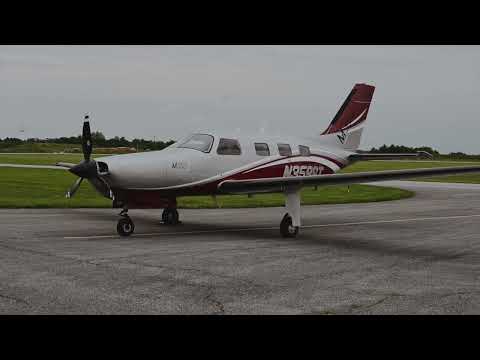
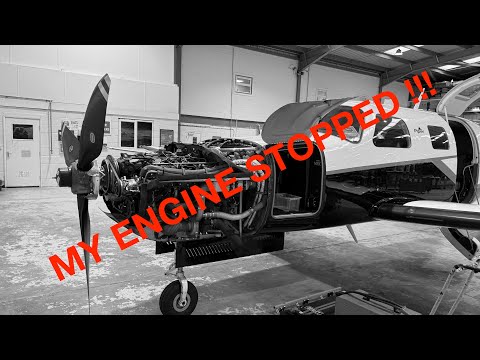
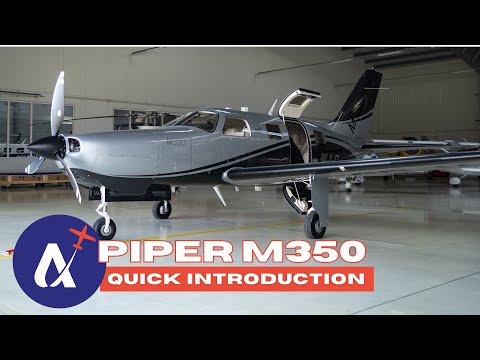
Articles and other links
-
Piper PA-46 (M-Class Family) - Wikipedia en.wikipedia.org
-
Piper M350 (Malibu Mirage) - AOPA Aircraft Guide www.aopa.org
-
Making Safety More Than A Mirage (Piper M350 Review) - Plane & Pilot planeandpilotmag.com
-
Piper PA-46 Malibu/Mirage/Matrix - Aviation Consumer aviationconsumer.com
-
Piper Launches M600 and M350 - FLYING Magazine www.flyingmag.com
-
M CLASS M350 Specifications, Performance, and Range - Globalair.com www.globalair.com
-
Piper M350 Gallery - International Aviation Support interaviation.jimdoweb.com
-
Piper Aircraft: M350 Aircraft www.piper.com