Range Map
Origin: → · two fingers to move map
Payload vs. Range
Fuel on board
Cargo
nm
Range
Trip Preview
Name a destination in the map header above and this becomes your trip: time en route, what you burn, what it costs, and whether you get there without stopping — at the load you have set.
→
Over max payload by . At this load it cannot lift a single occupant. Please adjust your payload inputs.
We do not have a cruise speed on file for this aircraft, so there is no honest time or cost to give you for this leg.
En route
Fuel burned
Direct cost
Fuel cost
Tanks run dry about past before at this burn.
Mission Profile
- High-Performance
- Complex
- High-Altitude
- Pressurization
- Instrument
_(4-9-2024).jpg)
Estimated Ownership Costs
Create a free account to view or request ownership cost data.
About the Piper M700
Type certificated 2024
Overview
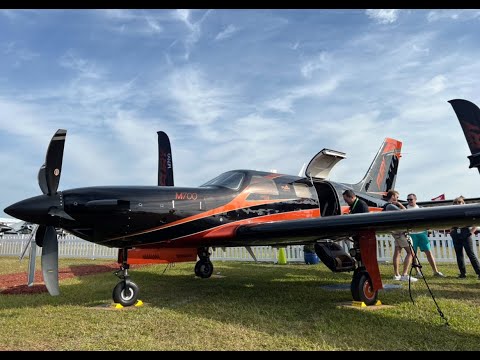
The Piper M700 Fury is the performance pinnacle of the PA-46 line and the fastest single-engine aircraft Piper has built. Introduced in 2024, it is powered by a Pratt and Whitney PT6A-52 producing 700 SHP, 100 SHP more than the PT6A-42A in the M600, flat-rated to maintain full power to FL240. The result is a 301-knot cruise speed and a published range of 1,852 NM: genuine long-range capability on a single tank with substantial reserves.
The M700 inherits the M600/SLS’s HALO Emergency Autoland system as standard equipment from delivery, and adds autothrottle and the Garmin G3000 with PlaneSync connectivity. Structurally the airframe is a refined version of the PA-46 platform that has been in production since 1983, with incremental improvements to short-field performance that give the M700 meaningfully better runway numbers than the M600 despite the higher gross weight. The M700 is positioned against the TBM 940 and Kodiak 900 as an owner-flown high-performance turboprop, and at 301 knots it competes credibly on speed. The honest case against it is practical rather than performance: the 43.2-ft wingspan will not fit a standard 40-ft T-hangar, full fuel leaves only about 550 lb for the cabin, and as a type certified new in 2024 the used market is still thin. It nonetheless suits the owner-pilot who flies long single-pilot legs, wants Emergency Autoland standard in the family aircraft, and can carry a new-turboprop acquisition and a dedicated hangar.
Key Features for GA Buyers
-
301-Knot Cruise. The M700 is a legitimate 300-knot machine, and at 1,852 NM of range it links most US city pairs nonstop: Los Angeles to Dallas or Miami to Chicago with meaningful reserves. No other PA-46 variant comes close, and the speed differential over the M600 (274 knots) compounds meaningfully on longer legs.
-
HALO Emergency Autoland as Standard. Unlike the M600 where HALO arrived as a later SLS variant, every M700 ships with Emergency Autoland certified and active. The system detects pilot incapacitation, selects an appropriate airport, sequences the approach autonomously, and lands the aircraft. For family-oriented buyers operating single-pilot IFR, no certified technology addresses pilot incapacitation more directly.
-
Short-Field Performance. The M700’s published takeoff distance over a 50-ft obstacle is 1,994 ft and landing distance is 1,950 ft, both meaningfully better than the M600’s figures despite the additional power and weight. This preserves access to the regional airport network that the M500’s longer distances increasingly restricted.
-
PT6A-52 Power Reserve. Flat-rating 700 SHP to FL240 means the engine is operating well below its structural limits at normal cruise settings. This translates to robust climb performance at altitude, a wide power reserve for emergencies, and a thermal margin that turbine engine operators value for longevity.
Trade-offs
- Hangar Constraints. The M700’s 43.2-ft wingspan exceeds the 40-ft standard T-hangar door width. A dedicated larger hangar is required, which adds cost and limits airport options at smaller fields.
- Fuel Load vs. Cabin Payload. Full tanks (260 gal / approximately 1,768 lb of Jet-A) against a 2,320-lb useful load leaves roughly 552 lb for cabin payload: two adults and substantial bags, or three adults travelling light. Full-fuel range and full-cabin occupancy are not simultaneously achievable.
- Fuel Burn. At 46 GPH in cruise, the M700 burns more than the M600 and substantially more than the M500. Owners flying shorter regional legs should model whether the speed premium justifies the additional fuel cost relative to the M600.
- New Aircraft Acquisition Cost. Current list pricing for the M700 exceeds $4 million. The used market is thin given the type’s recent introduction, which limits purchase flexibility and can extend pre-purchase inspection timelines.
See Also
- Piper M350 – the pressurised piston foundation of the PA-46 family: dramatically lower operating costs, substantially lower speed and ceiling. Compare
- Piper M500 – the turboprop entry point: same airframe lineage, lower acquisition cost, 260-knot cruise. Compare
- Piper M600 – the direct predecessor it succeeded: PT6A-42A power, 274-knot cruise, lower fuel burn. Compare
- Pilatus PC-12 – the cross-manufacturer benchmark: larger cabin and payload capacity, lower cruise speed, broader utility mission. Compare
- Daher TBM 940 – the primary speed competitor: 330-knot cruise, higher ceiling, different ownership ecosystem. Compare
Technical Specifications
Dimensions & Weights
- Height
- 12 ft
- Length
- 30 ft
- Parking area (ft²2)
- 1,846 ft²
- Max Takeoff Weight
- 6,000 lbs
- Max Landing Weight
- 5,800 lbs
- Useful Load
- 2,320 lbs
- Fuel Capacity
- 260 gal
Performance
- Cruise Speed
- 301 KTAS
- Never-Exceed (VNE)
- Source: FAA Type Certificate Data Sheet 251 KIAS
- Max Structural Cruise (VNO)
- Source: FAA Type Certificate Data Sheet 251 KIAS
- Approach Speed
- 85 KIAS
- Stall, Clean (VS1)
- 73 KIAS
- Range
- 1852 NM
- Service Ceiling
- 30,000 ft
- Rate of Climb
- 2048 - 3432 fpm
- Takeoff over 50 ft obstacle
- 1,994 ft
- Landing over 50 ft obstacle
- 1,950 ft
Engine
Log in to view or request powerplant data.
Sources
Where the figures on this page come from. Piper M700 specifications are traced to published references; estimated values are flagged inline next to the figure.
Similar to the Piper M700
Similar TurbopropsPiper M600
Epic E1000
Epic LT
Daher TBM 960
Daher TBM 940
Daher TBM 980
Piper M500
Daher TBM 850
Daher TBM 900
Daher TBM 700/700A
Compare the Piper M700 to other aircraft