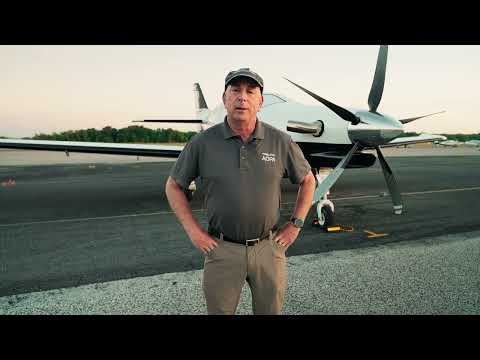
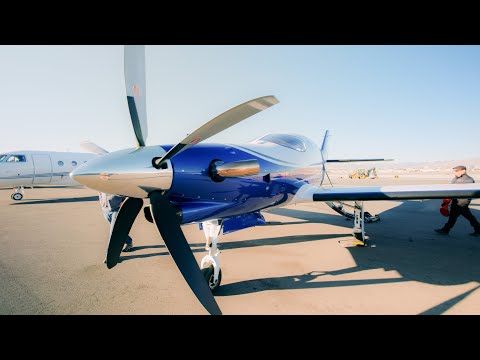
E1000
Turboprop • single engine • Low Wing • Retractable gear
Range Visualization
Origin: · click map to move · nm at current load
Payload vs. Range
Customize assumptions
Default: 190 lbs (FAA standard)
Default: 30 lbs
Mission Profile
- High-Performance
- Complex
- High-Altitude
- Pressurization
- Instrument
About the E1000
Overview
The Epic E1000 is a six-seat, single-engine turboprop built almost entirely of carbon fibre and certificated under FAR Part 23. Born from the experimental Epic LT kit airframe and FAA-certified in 2019, the type is positioned as a direct competitor to the Daher TBM series and Piper M600, with class-leading speed and climb performance among single-engine turboprops.
The catalogue covers the type across its three production variants under a single record. The original 2019 E1000 was followed by the E1000 GX (2020), which added Garmin Autoland and refined the cabin and avionics suite, and the E1000 AX (2024), which traded modest cruise for a sharp increase in useful load. All three share the airframe, certification basis, and Pratt & Whitney Canada PT6A-67A powerplant flat-rated at 1,200 SHP; the published scalars in this record align to the AX configuration as the most commercially relevant current production point, with the variant story preserved in this overview rather than served as a separate model entry.
Key Features for GA Buyers
- Class-leading speed. A 333 KTAS max cruise puts the E1000 ahead of most single-engine competitors in its bracket.
- Climb performance. The 1,200 SHP Pratt & Whitney PT6A-67A delivers an initial climb rate near 4,000 fpm, letting pilots reach the flight levels and smooth air quickly.
- Cabin comfort. Wider than many single-engine peers, pressurised to 6.6 psi, with Garmin G1000 NXi avionics on the original and GX, and Garmin Autoland from the GX onward.
- Payload utility. The AX variant’s useful load approaching 2,860 lbs is a rarity in the single-engine turboprop class and lets all six seats fill without compromising fuel.
Trade-offs
- Acquisition and operating cost. As a high-performance turbine aircraft, acquisition runs in the multi-million-dollar bracket and operating costs sit well above piston alternatives.
- Runway requirements. Takeoff and landing distances over a 50-ft obstacle (roughly 2,200 to 2,400 ft) are longer than STOL-capable turboprops such as the Pilatus PC-12.
- Single-engine reliance. Routine operation in the flight levels relies on glide performance and emergency procedures in the event of a powerplant failure. Buyers prioritising twin redundancy for that profile look to cabin-class twin turboprops rather than the E1000.
See Also
- Daher TBM 960 – Direct competitor; faster single-engine turboprop with Garmin G3000 and electronic propeller control. Compare
- Piper M600 – Direct competitor with Garmin G3000 HALO autoland in the single-engine turboprop class. Compare
- Pilatus PC-12 – Step-up to a higher-payload, single-engine turboprop with shorter-field performance. Compare
- Piper M500 – Step-down single-engine turboprop in a lighter, slower bracket. Compare
Featured in our buying guides
Technical Specifications
Dimensions
- Wingspan
- 43.0 ft
- Length
- 35.83 ft
- Height
- 13.83 ft
- Parking area (ft2)
- 2163.99 ft2
Weights
- Max Takeoff Weight
- 8,000 lbs
- Max Landing Weight
- 7,600 lbs
- Useful Load
- 2,860 lbs
- Fuel Capacity
- 288 gal
Performance
- Cruise Speed
- 333 KTAS
- Never-Exceed (Vne)
- 358 KIAS
- Approach Speed
- 95 KIAS
- Stall, Clean (Vs1)
- 88 KIAS
- Range
- 1560 NM
- Service Ceiling
- 34,000 ft
- Rate of Climb
- 4000 fpm
- Takeoff over 50 ft obstacle
- 2,254 ft
- Landing ground roll
- 2,399 ft
Similar to the E1000
TBM 940
Daher TBM 960
Piper M600
Socata TBM-700/700A
Piper M700
Piper M500
See how the E1000 stacks up against similar aircraft