Range Map
Origin: → · two fingers to move map
Payload vs. Range
Fuel on board
Cargo
nm
Range
Trip Preview
Name a destination in the map header above and this becomes your trip: time en route, what you burn, what it costs, and whether you get there without stopping — at the load you have set.
→
Over max payload by . At this load it cannot lift a single occupant. Please adjust your payload inputs.
We do not have a cruise speed on file for this aircraft, so there is no honest time or cost to give you for this leg.
En route
Fuel burned
Direct cost
Fuel cost
Tanks run dry about past before at this burn.
Mission Profile
- High-Performance
- Complex
- High-Altitude
- Pressurization
- Instrument
.jpg)
Estimated Ownership Costs
Create a free account to view or request ownership cost data.
About the Piper M500
Type certificated 2000
Overview
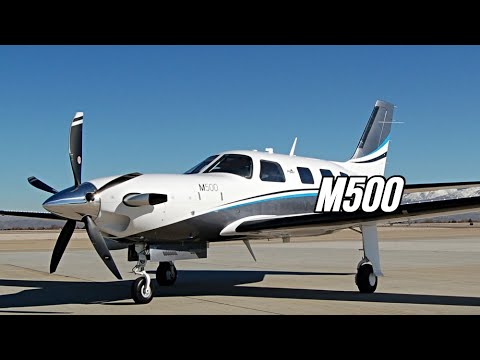
The Piper M500 is the entry point to PA-46 turboprop ownership and the aircraft that defined the owner-flown single-engine turboprop category. Its origins trace to the PA-46-500TP Meridian, introduced in 2000 as a turboprop conversion of the same PA-46 airframe used by the piston Malibu Mirage. The M500 designation arrived in 2015 alongside the G1000 NXi avionics upgrade that substantially expanded the aircraft’s safety technology baseline.
Powered by a Pratt and Whitney PT6A-42A flat-rated to 500 SHP, the M500 cruises at 260 knots at FL280 and carries six occupants in a pressurised cabin. The PT6 engine is the foundation of the type’s appeal: it is among the most proven turbine powerplants in general aviation, with a deep maintenance network, a 3,600-hour TBO, and an operational simplicity that represents a genuine step change from the high-performance piston aircraft it typically replaces. Mixture management, cowl flaps, and magneto checks are gone, and the power management philosophy is more forgiving than a turbocharged piston at altitude. The mission that fits the M500 is the roughly 1,000 NM regional trip flown behind a turbine: a buyer who wants PT6A simplicity and a pressurised cabin at the lowest entry cost in the M-class, and whose legs rarely exceed what 170 gallons will carry, is matched to this airplane rather than the longer-legged M600 or M700.
Key Features for GA Buyers
-
PT6A Reliability and Simplicity. The PT6A-42A’s reverse-flow design, single-lever power management, and established overhaul network make it one of the more approachable turbine transitions for owner-pilots moving up from complex pistons. The 3,600-hour TBO is meaningful: at 200 hours per year, that is 18 years of flying between overhauls under ideal conditions.
-
Active Safety Systems. The G1000 NXi suite includes Electronic Stability Protection, Automatic Level Mode, and Underspeed Protection. Automatic Level Mode in particular has real operational significance: it can recover the aircraft from an unusual attitude with a single button press, a capability that addresses the leading cause of fatal GA accidents.
-
FL280 Operations. The M500 can cruise at FL280, well above the M350’s FL250 ceiling and comfortably above most convective activity in the continental United States. The pressurisation system maintains a comfortable cabin altitude throughout.
-
Useful Load Advantage over the M350. At 1,698 lb, the M500’s useful load is 390 lb more than the M350’s. With 170 gallons (about 1,190 lb) of fuel, that leaves approximately 508 lb for payload: similar fuel-payload dynamics, but with significantly more range on full tanks.
Trade-offs
- Fuel Burn. At 35 GPH of Jet-A, the M500 burns roughly 67% more fuel per hour than the M350. The operating cost step from piston to turboprop is real and should be modelled over the anticipated mission profile before committing.
- Payload with Full Fuel. 170 gallons leaves limited cabin payload. Like all PA-46 variants, the M500 rewards owners who plan fuel loads deliberately rather than departing full tanks on every leg.
- Runway Requirements. The M500’s takeoff and landing distances are longer than many buyers expect from a single of this size, requiring at least 3,000 ft of runway for comfortable margins. Access to shorter strips is restricted compared to the M600 or M700.
- Transition Training. The turbine type rating and recurrent training requirements add a fixed cost overhead that piston owners do not carry. Factor this into total annual cost of ownership.
See Also
- Piper M350 – the pressurised piston predecessor on the same airframe: lower fuel burn, lower acquisition cost, lower ceiling. Compare
- Piper M600 – the longer-range turboprop tier that followed, since succeeded by the M700: more fuel, more range, and the Garmin G3000 with Autoland. Compare
- Piper M700 – the performance flagship of the M-class line: 301 knots and the full HALO emergency autoland system. Compare
- Pilatus PC-12 – the principal cross-manufacturer alternative: larger cabin, greater payload, more utility-oriented mission profile. Compare
- Daher TBM 850 – the higher-performance single-engine turboprop alternative: faster cruise, higher ceiling, different ownership community. Compare
Featured in our buying guides
Technical Specifications
Dimensions & Weights
- Height
- 11 ft
- Length
- 30 ft
- Parking area (ft²2)
- 1,834 ft²
- Max Takeoff Weight
- 5,092 lbs
- Max Landing Weight
- 4,850 lbs
- Useful Load
- 1,698 lbs
- Fuel Capacity
- 170 gal
Performance
- Cruise Speed
- 260 KTAS
- Never-Exceed (VNE)
- Source: FAA Type Certificate Data Sheet 188 KIAS
- Max Structural Cruise (VNO)
- Source: FAA Type Certificate Data Sheet 188 KIAS
- Approach Speed
- 85 KIAS
- Stall, Clean (VS1)
- 69 KIAS
- Range
- 1000 NM
- Service Ceiling
- 30,000 ft
- Rate of Climb
- 1556 fpm
- Takeoff over 50 ft obstacle
- 2,438 ft
- Landing over 50 ft obstacle
- 2,110 ft
Engine
Log in to view or request powerplant data.
Sources
Where the figures on this page come from. Piper M500 specifications are traced to published references; estimated values are flagged inline next to the figure.
-
FAA TCDS A25SO Rev 9, Section III Model PA-46-500TP (Malibu Meridian) — Airspeed Limits. The 500TP is a single-VMO airframe with no separate VNE; the never-exceed limit is the maximum operating speed. www.malibuaerospace.com
-
EASA TCDS IM.A.077 Issue 22, Section C Model PA-46-500TP — Air Speeds www.easa.europa.eu
Similar to the Piper M500
Similar TurbopropsPiper M600
Piper M700
Epic E1000
Epic LT
Daher TBM 850
Daher TBM 700/700A
Daher TBM 960
Daher TBM 980
Compare the Piper M500 to other aircraft
External Media



Articles and other links
-
Piper PA-46 M-Class (M500/Meridian) - Wikipedia en.wikipedia.org
-
Piper M500 Aircraft Guide - AOPA www.aopa.org
-
Upgraded Meridian: A Closer Look At The Piper M500 - Simple Flying simpleflying.com
-
Piper Meridian: Everyman's Turbine - Plane + Pilot Magazine planeandpilotmag.com
-
Pilot Report: Piper PA-46 M500 - Aviation International News www.ainonline.com