Range Map
Origin: → · two fingers to move map
Payload vs. Range
Fuel on board
Cargo
nm
Range
Trip Preview
Name a destination in the map header above and this becomes your trip: time en route, what you burn, what it costs, and whether you get there without stopping — at the load you have set.
→
Over max payload by . At this load it cannot lift a single occupant. Please adjust your payload inputs.
We do not have a cruise speed on file for this aircraft, so there is no honest time or cost to give you for this leg.
En route
Fuel burned
Direct cost
Fuel cost
Tanks run dry about past before at this burn.
Mission Profile
- High-Performance
- Complex
- High-Altitude
- Pressurization
- Multi-Engine
.jpg)
Estimated Ownership Costs
Create a free account to view or request ownership cost data.
About the Piper PA-31P-350 Mojave
Type certificated 1983 Source: FAA Type Certificate Data Sheet
Overview
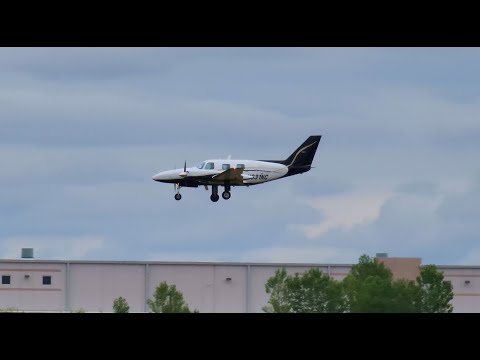
The Piper PA-31P-350 Mojave is the rare final pressurised piston twin in the PA-31 family. Built only between 1983 and June 1984 with just 50 airframes produced, the Mojave grafts the 350 hp Lycoming TIO-540-V2AD piston pair onto the pressurised fuselage of the turboprop Cheyenne I, with a strengthened and span-extended Chieftain wing and Chieftain tail. The result is what owners and the contemporary aviation press called the piston Cheyenne.
The design rationale was specific. By the early 1980s owners wanted high-altitude pressurised comfort but were priced out of new turboprops. Piper’s response was to take the airframe already certified for the Cheyenne I, fit it with a modified Chieftain wing and tail, and substitute upgraded piston engines optimised for high-altitude operation. The result delivers FIKI certification, a 26,500 ft service ceiling, and roughly 1,190 nm range at a fraction of a Cheyenne’s acquisition cost, at the price of the higher operating complexity of any pressurised piston twin.
The Mojave was the last twin Piper built in Lock Haven, Pennsylvania before the line closed. Its single-year production run, the narrow buyer pool the type attracted, and the difficult economics of new pressurised piston twins by 1984 explain the small fleet and its current rarity in the resale market. The Mojave fits the owner who wants turboprop-style pressurised, high-altitude comfort and roughly 1,190 nm of range without buying a turboprop, and who accepts the cost and complexity of a pressurised piston twin to get it; it is the wrong airplane for a buyer who needs hot-and-high performance or a deep parts and service network, neither of which a 50-airframe type can offer.
Key Features for GA Buyers
- Pressurised Cabin from the Cheyenne I: The Mojave inherits the pressurised fuselage certified for the turboprop PA-31T, including its 5.5 psi differential. That maintains a sea-level cabin to roughly 12,000 ft and a 10,000 ft cabin at FL250, making long cross-country legs significantly more comfortable than any unpressurised PA-31.
- Cheyenne-Class Airframe: Sharing structure with the Cheyenne I gives the Mojave thicker fuselage skins, a dual-bus electrical system, and overbuilt landing gear by piston-twin standards. The Chieftain wing is strengthened and the span is extended 4 ft over the Chieftain, with fuel capacity enlarged to support transcontinental missions.
- Range and Fuel: 238 gallon fuel capacity yields about 1,190 nm range, supporting non-stop legs that piston twins of similar power cannot match.
- High-Altitude Engines: The Lycoming TIO-540-V2AD pair was specified for high-altitude operation with intercoolers and pressurised magnetos from the factory, and carries a 2,000 hour published TBO. Counter-rotating propellers eliminate the critical-engine penalty on a balked single-engine departure.
Trade-offs
- Sluggish Takeoff: 7,200 lb MTOW on 700 total horsepower yields a 3,035 ft takeoff distance over a 50 ft obstacle, materially longer than the Chieftain. Hot and high operations are limited and the single-engine service ceiling is roughly 14,300 ft.
- Engine Complexity and Cost: The TIO-540-V2AD’s intercoolers, pressurised magnetos, and high-altitude tuning add maintenance complexity and per-event overhaul cost relative to the Chieftain’s J2BD, and a real overhaul can run above the Gann standard-shop anchor of $67,500 per side. Its longer 2,000 hr TBO (200 hr above the Chieftain’s 1,800 hr) does spread that reserve thinner per hour, to roughly $67.50.
- Rarity and Parts: With only 50 built and roughly half that number active in the FAA registry today, model-specific airframe parts unique to the Mojave hybrid (not shared with Cheyenne I or Chieftain) can be difficult to source. Type-experienced maintenance is concentrated in a few shops.
- Single-Year Production: Built only 1983 to mid-1984 before Piper shut down the pressurised piston program. The narrow vintage band keeps both the buyer pool and the sale comparison set small, which both supports residual value and complicates appraisal.
See Also
- Piper PA-31-350 Chieftain – Unpressurised piston sibling at lower acquisition cost; the Mojave inherits its wing and tail in strengthened, span-extended form. Compare
- Piper Cheyenne I – Turboprop sibling sharing the pressurised fuselage; the Mojave is its piston counterpart at materially lower acquisition cost. Compare
- Cessna 421C Golden Eagle – The dominant pressurised piston twin from Wichita and the Mojave’s direct period rival in the cabin-class market. Compare
- Cessna Chancellor 414 – A slightly smaller and less ambitious pressurised piston twin alternative from Cessna. Compare
- Beechcraft Duke 60 – The high-performance pressurised piston twin from Beechcraft, distinct in size, mission, and operating economics. Compare
Technical Specifications
Dimensions & Weights
- Height
- 13 ft
- Length
- 34 ft
- Parking area (ft²2)
- 2,153 ft²
- Max Takeoff Weight
- 7,200 lbs
- Max Landing Weight
- 7,000 lbs
- Useful Load
- 2,130 lbs
- Fuel Capacity
- 238 gal
Performance
- Cruise Speed
- 220 KTAS
- Never-Exceed (VNE)
- Source: FAA Type Certificate Data Sheet 236 KIAS
- Max Structural Cruise (VNO)
- Source: FAA Type Certificate Data Sheet 187 KIAS
- Approach Speed
- 90 KIAS
- Stall, Clean (VS1)
- 75 KIAS
- Range
- 1190 NM
- Service Ceiling
- 26,500 ft
- Rate of Climb
- 255 - 1445 fpm
- Takeoff over 50 ft obstacle
- 3,035 ft
- Landing over 50 ft obstacle
- 2,305 ft
Engines
Log in to view or request powerplant data.
Sources
Where the figures on this page come from. Piper PA-31P-350 Mojave specifications are traced to published references; estimated values are flagged inline next to the figure.
Similar to the Piper PA-31P-350 Mojave
Similar PistonsPiper PA-31P Pressurized Navajo
Cessna 340
Piper Navajo PA-31
Aero Commander 680FP
Rockwell Commander 685
Compare the Piper PA-31P-350 Mojave to other aircraft
External Media
Articles and other links
-
Plane & Pilot: Piper Mojave — The Piston Cheyenne planeandpilotmag.com
-
Aviation Consumer: Piper Navajo and Mojave Family Review aviationconsumer.com
-
Wikipedia: Piper PA-31 Navajo (Mojave section) en.wikipedia.org
-
Flying Magazine: 1984 PA-31P-350 Mojave — Long-Range, High-Flying Top Pick www.flyingmag.com
-
-
PlanePhD: PA-31P-350 Mojave Specifications, Performance, Operating Cost & Valuation planephd.com
-
Global Air: Mojave PA-31P-350 Specifications, Performance, and Range www.globalair.com
-
Aero Resources: 1983 Piper PA-31P-350 Mojave — October 1983 Pilot Report (archival) www.aeroresourcesinc.com