Range Map
Origin: → · two fingers to move map
Payload vs. Range
Fuel on board
Cargo
nm
Range
Trip Preview
Name a destination in the map header above and this becomes your trip: time en route, what you burn, what it costs, and whether you get there without stopping — at the load you have set.
→
Over max payload by . At this load it cannot lift a single occupant. Please adjust your payload inputs.
We do not have a cruise speed on file for this aircraft, so there is no honest time or cost to give you for this leg.
En route
Fuel burned
Direct cost
Fuel cost
Tanks run dry about past before at this burn.
Mission Profile
- High-Performance
- Complex
- Multi-Engine

Estimated Ownership Costs
Create a free account to view or request ownership cost data.
About the Piper PA-31-350 Chieftain
Type certificated 1972 Source: FAA Type Certificate Data Sheet
Overview
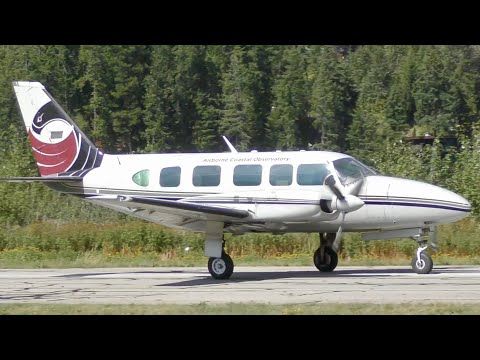
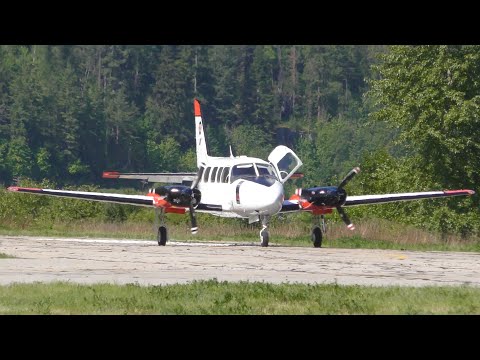
The Piper PA-31-350 Chieftain is a ten-seat piston-twin commuter, with 1,825 airframes produced from 1973 through 1984. Stretched two feet from the parent Navajo and uprated to 350 hp Lycoming TIO-540 / LTIO-540 counter-rotating engines, the Chieftain became the standard piston commuter twin during the deregulation era and remains in active freight and Part 135 operation worldwide.
The counter-rotating powerplant arrangement was the key engineering decision. The original Navajo’s conventional rotation produced a difficult critical-engine handling problem on engine-out, and the Chieftain’s mirrored propellers cured it. Combined with the 7,000 lb gross weight and 2,600+ lb useful load, the airframe set the template for high-density commuter and cargo operations that single-engine and lighter twins could not match. That history still describes its owner: the Chieftain is an operator’s airplane, flown today mainly by the Part 135 charter, light-freight, and regional commuter outfits that need to move up to ten seats or roughly 1,500 lb of cargo on a piston budget, and that accept the fuel burn and twin-engine upkeep as the price of that capability.
Key Features for GA Buyers
- Heavy Hauler: Useful load above 2,600 lb supports a full passenger load with baggage, or roughly 1,500 lb of cargo at typical IFR fuel reserves.
- Counter-Rotating Engines: Mirrored TIO-540 / LTIO-540 propellers eliminate the critical-engine handling problem that plagued the earlier Navajo, reducing single-engine accident severity and simplifying training.
- Cabin Volume: The 12.5 ft long, 4 ft wide cabin seats up to ten in commuter configuration, with a true cabin-class entry door and headroom that piston-twin owners often rate above pressurised competitors.
- Operator Support: Nearly 1,825 built and decades of Part 135 service mean parts, mechanics, and type-experienced instructors are widely available, an advantage over rarer cabin-class twins.
Trade-offs
- Fuel Thirst: Cruise burn of approximately 43.6 GPH at 75% power is roughly double a piston single and well above the 310 hp Navajo. Charter and freight economics depend on filling seats or cargo to keep the per-mile cost reasonable.
- Engine Costs: Lycoming TIO-540 / LTIO-540 overhauls run approximately $67,500 per side on the catalogue’s Gann Aviation TIO-540 spine, roughly $135,000 for the counter-rotating pair, and the J2BD-series cylinders are historically prone to shock-cooling damage. Disciplined power management is critical to reaching the 1,800 hr published TBO.
- Unpressurised: Service ceiling is 24,000 ft, but most operations cruise FL120 to FL180. Long-haul comfort suffers compared to the pressurised Mojave or Cheyenne siblings.
- Maintenance Complexity: Turbocharged engines plus hydraulic gear and flap systems generate higher annual costs than owner-flown light twins, and the type’s heavy commercial utilization shows up in fleet maintenance costs well above lighter cabin twins. Budget commercially even for private operation.
See Also
- Piper Navajo PA-31 – the 310 hp parent type the Chieftain stretched from. Compare
- Piper PA-31T3-500 T-1040 – the turboprop sibling on the same fuselage, with PT6A-11 engines. Compare
- Piper PA-31P-350 Mojave – the pressurised piston sibling for higher-altitude weather avoidance. Compare
- Cessna 402 – the direct commuter piston twin competitor from Wichita. Compare
- Beechcraft Baron 58 – the lighter cabin-class piston twin alternative for owner-flown missions. Compare
Technical Specifications
Dimensions & Weights
- Height
- 13 ft
- Length
- 35 ft
- Parking area (ft²2)
- 2,010 ft²
- Max Takeoff Weight
- 7,000 lbs
- Max Landing Weight
- 7,000 lbs
- Useful Load
- 2,681 lbs
- Fuel Capacity
- 182 gal
Performance
- Cruise Speed
- 211 KTAS
- Never-Exceed (VNE)
- Source: FAA Type Certificate Data Sheet 236 KIAS
- Max Structural Cruise (VNO)
- Source: FAA Type Certificate Data Sheet 187 KIAS
- Approach Speed
- 98 KIAS
- Stall, Clean (VS1)
- 74 KIAS
- Range
- 883 NM
- Service Ceiling
- 24,000 ft
- Rate of Climb
- 230 - 1120 fpm
- Takeoff over 50 ft obstacle
- 2,510 ft
- Landing over 50 ft obstacle
- 2,291 ft
Engines
Log in to view or request powerplant data.
Sources
Where the figures on this page come from. Piper PA-31-350 Chieftain specifications are traced to published references; estimated values are flagged inline next to the figure.
Similar to the Piper PA-31-350 Chieftain
Similar PistonsBeechcraft 18
Cessna 402
Cessna 404 Titan
Compare the Piper PA-31-350 Chieftain to other aircraft
External Media
Articles and other links
-
AOPA Fact Sheet: Piper Navajo and Chieftain Family www.aopa.org
-
-
Wikipedia: Piper PA-31 Navajo (Chieftain section) en.wikipedia.org
-
Aviation Consumer: Piper PA-31 Navajo and Chieftain Review aviationconsumer.com
-
Pilot: Flight Test — Piper PA-31 Navajo Chieftain pilotweb.aero