Range Map
Origin: → · two fingers to move map
Payload vs. Range
Fuel on board
Cargo
nm
Range
Trip Preview
Name a destination in the map header above and this becomes your trip: time en route, what you burn, what it costs, and whether you get there without stopping — at the load you have set.
→
Over max payload by . At this load it cannot lift a single occupant. Please adjust your payload inputs.
We do not have a cruise speed on file for this aircraft, so there is no honest time or cost to give you for this leg.
En route
Fuel burned
Direct cost
Fuel cost
Tanks run dry about past before at this burn.
Mission Profile
- High-Performance
- Complex
- High-Altitude
- Pressurization
- Multi-Engine
- Instrument
.jpg)
Estimated Ownership Costs
Create a free account to view or request ownership cost data.
About the Piper Cheyenne I
Type certificated 1978 Source: FAA Type Certificate Data Sheet
Overview
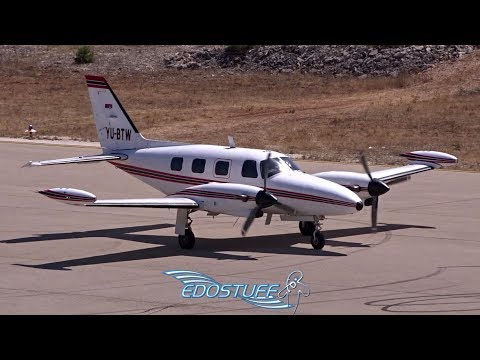
The Piper PA-31T1 Cheyenne I is the entry-level model of Piper’s PT6-powered turboprop family. Powered by two 500 shp Pratt & Whitney Canada PT6A-11 engines on the same airframe used by the Cheyenne II, it was certified in 1978 and built specifically to compete with the Beechcraft King Air C90 at a lower acquisition cost. The lower-rated engines mean the Cheyenne I does not require the Stability Augmentation System mandatory on the Cheyenne II, making it a friendlier handling airplane and a more natural step-up from a piston twin.
The Cheyenne I trades top-end speed for predictability. Cruise sits around 249 knots versus the II’s 283, and the standard 308-gallon fuel system limits range to roughly 880 to 1,000 nm at typical cruise; later Cheyenne IA examples with tip tanks extend that meaningfully. In return, the airplane is widely described as one of the most forgiving turboprops to transition into, with maintenance and dispatch reliability that pilots moving up from a Chieftain or Navajo notice immediately.
189 Cheyenne Is were built, with the IA refresh adding a few minor improvements through 1985. As of recent surveys roughly 143 remain on the FAA registry, and Vref-style pricing typically lands in the $340,000 to $470,000 band depending on year, total time, and tip-tank equipment. This makes the Cheyenne I right for the piston-twin owner stepping up to turbine reliability and a pressurised cabin at the low end of the twin-turboprop acquisition range, content with a 249-knot cruise and the standard 308-gallon tanks’ shorter legs. It is the wrong airplane for a buyer who needs to cover 500-plus NM legs at top speed: that mission belongs to the faster Cheyenne II or a King Air, not the entry model.
Key Features for GA Buyers
- No SAS requirement. The 500 shp PT6A-11 installation is below the threshold that drove the Cheyenne II’s mandatory Stability Augmentation System. Handling is more conventional and pre-purchase diligence is simpler.
- Pressurised cabin. 5.5 psi differential maintains sea-level cabin altitude to roughly 12,000 ft and a comfortable cabin altitude in the high 20s.
- Turbine economics for the segment. Published cruise fuel flow around 66 GPH and PT6A-11 TBO of 3,600 hours give the Cheyenne I one of the lower variable-cost profiles in the cabin-class twin turboprop market.
- Six- to seven-seat cabin. Two pilots plus four facing passengers in club configuration, with a side-facing seat against the starboard fuselage on most layouts.
Trade-offs
- Standard fuel capacity is modest. 308 gallons in the standard configuration limits practical range to roughly 880 nm at standard cruise. Tip-tank-equipped IA examples carry 390 gallons and extend range materially; verify the equipment list before committing on range.
- Speed is the price of friendlier handling. 249 knot cruise is roughly 30 knots slower than the Cheyenne II and noticeably slower than the King Air F90 or 100. Acceptable for shorter legs; less competitive on 500-plus nm trips.
- Payload with full fuel. Useful load is roughly 3,800 lb but turbine fuel weight consumes that quickly. Plan trips with realistic payload-versus-range trade-offs.
- Aging avionics and systems. Production ended in 1985. Many airframes need avionics modernisation to stay current with ADS-B and modern IFR expectations.
See Also
- Piper Cheyenne II – 620 shp sibling with stronger climb and 283 knot cruise, at the cost of mandatory SAS. Compare
- Beechcraft King Air 90 – the C90 was the named target Piper designed the Cheyenne I to undercut on acquisition price. Compare
- Cessna 425 Conquest I – contemporary PT6-powered twin turboprop in the same weight class. Compare
- Beechcraft King Air F90 – mid-size King Air variant for buyers cross-shopping the entry segment. Compare
- Piper PA-31-350 Chieftain – the piston twin most Cheyenne I buyers transition out of. Compare
Technical Specifications
Dimensions & Weights
- Height
- 13 ft
- Length
- 35 ft
- Parking area (ft²2)
- 2,010 ft²
- Max Takeoff Weight
- 8,700 lbs
- Max Landing Weight
- 8,700 lbs
- Useful Load
- 3,800 lbs
- Fuel Capacity
- 308 gal
Performance
- Cruise Speed
- 249 KTAS
- Never-Exceed (VNE)
- Source: FAA Type Certificate Data Sheet 230 KIAS
- Max Structural Cruise (VNO)
- Source: FAA Type Certificate Data Sheet 230 KIAS
- Approach Speed
- 105 KIAS
- Stall, Clean (VS1)
- 86 KIAS
- Range
- 861 NM
- Service Ceiling
- 29,000 ft
- Rate of Climb
- 440 - 1750 fpm
- Takeoff over 50 ft obstacle
- 2,444 ft
- Landing over 50 ft obstacle
- 2,263 ft
Engines
Log in to view or request powerplant data.
Sources
Where the figures on this page come from. Piper Cheyenne I specifications are traced to published references; estimated values are flagged inline next to the figure.
Similar to the Piper Cheyenne I
Similar TurbopropsPiper Cheyenne II
Cessna 425 Conquest I
Compare the Piper Cheyenne I to other aircraft
External Media


Articles and other links
-
AOPA - Quick Look: Piper Cheyenne I & IA www.aopa.org
-
GlobalAir - Piper Cheyenne I Specifications www.globalair.com
-
JetAv - Piper Cheyenne I Performance & Specs jetav.com
-
Wikipedia - Piper PA-31T Cheyenne en.wikipedia.org
-
Aviation Consumer - Piper PA-31T Cheyenne Review aviationconsumer.com
-
Atlantic Jet Partners - Introduction to the Piper Cheyenne PA-31T1 atlanticjetpartners.com