Range Map
Origin: → · two fingers to move map
Payload vs. Range
Fuel on board
Cargo
nm
Range
Trip Preview
Name a destination in the map header above and this becomes your trip: time en route, what you burn, what it costs, and whether you get there without stopping — at the load you have set.
→
Over max payload by . At this load it cannot lift a single occupant. Please adjust your payload inputs.
We do not have a cruise speed on file for this aircraft, so there is no honest time or cost to give you for this leg.
En route
Fuel burned
Direct cost
Fuel cost
Tanks run dry about past before at this burn.
Mission Profile
- High-Performance
- Complex
- High-Altitude
- Pressurization
- Multi-Engine
- Instrument

Estimated Ownership Costs
Create a free account to view or request ownership cost data.
About the Piper Cheyenne II
Type certificated 1972 Source: FAA Type Certificate Data Sheet
Overview
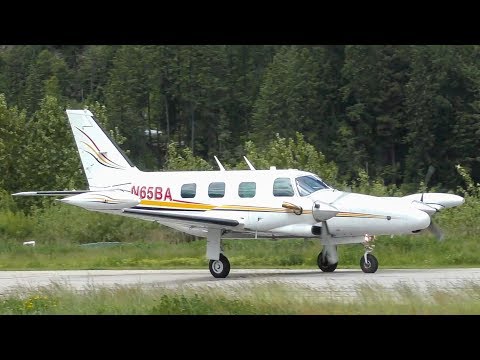
The Piper PA-31T Cheyenne II is the first of Piper’s PT6-powered turboprops and the variant that established the family. Powered by two 620 shp Pratt & Whitney Canada PT6A-28 engines on a short-coupled airframe derived from the Navajo, it delivers exceptional climb performance and a 283 knot cruise that put it in direct contention with the Beechcraft King Air 90 of the same era.
The trade for that performance is handling. The combination of high power and short fuselage produced longitudinal stability concerns at high angles of attack and aft CG, leading Piper to certify the Cheyenne II with a mandatory Stability Augmentation System. The SAS is part of the type, not optional, and a buyer’s preflight diligence on the system’s condition is non-negotiable.
In the used market the Cheyenne II typically sits below the Cheyenne I and the stretched IIXL on price, largely on its SAS-driven handling reputation. Within the cabin-class turboprop field, the Cheyenne II is the speed-per-purchase-dollar play: it cruises at 283 knots, 34 knots faster than the gentler Cheyenne I, yet typically trades below it on the used market. That bargain holds only for a pilot with the type training to manage the SAS and the short-coupled pitch; without that currency, a King Air 90 is the safer choice.
Key Features for GA Buyers
- Power-to-weight. 620 shp per side at 9,000 lb MTOW yields a sea-level climb rate above 2,800 fpm and direct ascent to the flight levels.
- Range with tip tanks. Standard tip tanks bring total fuel to 382 gallons, supporting a published range of roughly 1,350 nm at long-range cruise.
- Pricing. Lower acquisition cost than Cheyenne I or IIXL on the used market, and frequently described as one of the lowest-cost twin turboprops to operate when maintained well.
- Pressurised cabin. Seating for up to seven in a pressurised cabin with cruise altitudes to FL310.
Trade-offs
- Mandatory Stability Augmentation System. The SAS is required equipment, certified to address longitudinal stability behavior at high AoA. SAS health is a primary diligence item on any pre-purchase inspection.
- Pitch handling. Short-coupled airframe makes pitch control more sensitive than the stretched IIXL or competing King Air 90, particularly during takeoff and landing.
- Cabin noise. Engines mounted close to the fuselage produce a louder cabin than the IIXL or King Air series of the same vintage.
- Pilot transition. Not an aircraft for first-time turboprop pilots without proper type-specific training.
See Also
- Piper Cheyenne I – lighter sibling with 500 shp PT6A-11 engines and gentler handling. Compare
- Piper PA-42-720 Cheyenne III – stretched T-tail successor with higher useful load and longer range. Compare
- Beechcraft King Air 90 – the era’s primary direct competitor and the benchmark Piper designed to undercut. Compare
- Cessna 425 Conquest I – contemporary PT6-powered twin turboprop in the same weight class. Compare
- Mitsubishi Marquise/Solitaire – MU-2 series direct competitor with a different design philosophy. Compare
Technical Specifications
Dimensions & Weights
- Height
- 13 ft
- Length
- 35 ft
- Parking area (ft²2)
- 2,089 ft²
- Max Takeoff Weight
- 9,000 lbs
- Max Landing Weight
- 9,000 lbs
- Useful Load
- 3,600 lbs
- Fuel Capacity
- 382 gal
Performance
- Cruise Speed
- 283 KTAS
- Never-Exceed (VNE)
- Source: FAA Type Certificate Data Sheet 246 KIAS
- Max Structural Cruise (VNO)
- Source: FAA Type Certificate Data Sheet 246 KIAS
- Approach Speed
- 91 KIAS
- Stall, Clean (VS1)
- 86 KIAS
- Range
- 1350 NM
- Service Ceiling
- 31,000 ft
- Rate of Climb
- 660 - 2800 fpm
- Takeoff over 50 ft obstacle
- 1,980 ft
- Landing over 50 ft obstacle
- 2,500 ft
Engines
Log in to view or request powerplant data.
Sources
Where the figures on this page come from. Piper Cheyenne II specifications are traced to published references; estimated values are flagged inline next to the figure.
Similar to the Piper Cheyenne II
Similar TurbopropsPiper Cheyenne I
Cessna 425 Conquest I
Commander 690
Piper PA-42 Cheyenne III
Compare the Piper Cheyenne II to other aircraft
External Media
Articles and other links
-
JetAv - Piper Cheyenne II Performance Data jetav.com
-
AOPA - Piper Cheyenne History and Safety Review www.aopa.org
-
GlobalAir - Piper Cheyenne II PA-31T Specifications www.globalair.com
-
Wikipedia - Piper PA-31T Cheyenne en.wikipedia.org
-
Aviation Consumer - Piper PA-31T Cheyenne Review aviationconsumer.com
-
Business Jet Traveler - Piper Cheyenne II bjtonline.com