Range Map
Origin: → · two fingers to move map
Payload vs. Range
Fuel on board
Cargo
nm
Range
Trip Preview
Name a destination in the map header above and this becomes your trip: time en route, what you burn, what it costs, and whether you get there without stopping — at the load you have set.
→
Over max payload by . At this load it cannot lift a single occupant. Please adjust your payload inputs.
We do not have a cruise speed on file for this aircraft, so there is no honest time or cost to give you for this leg.
En route
Fuel burned
Direct cost
Fuel cost
Tanks run dry about past before at this burn.
Mission Profile
- High-Altitude
- Pressurization
- Multi-Engine
- Instrument

Estimated Ownership Costs
Create a free account to view or request ownership cost data.
About the Dassault Falcon/Mystère 20
Type certificated 1965 Source: FAA Type Certificate Data Sheet
Overview
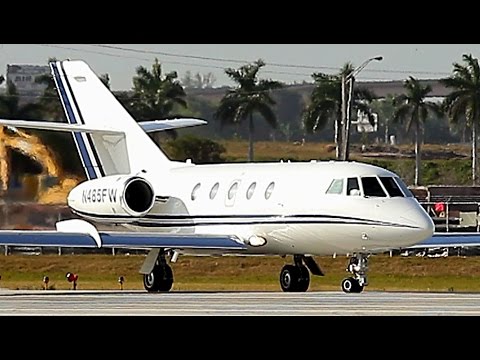
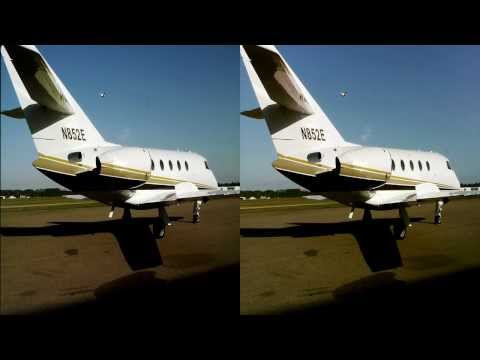
The Dassault Falcon 20, originally the Mystère 20, and certificated by the FAA as the Fan Jet Falcon, is the aircraft that launched Dassault’s business-jet line and, in freighter form, launched Federal Express. First flown in 1963 and type-certificated in 1965, it is a French-built mid-size twinjet with aft-mounted engines, a low tail, and the area-ruled fuselage that became the visual signature of the Falcon family; more than 500 were built across the 20C, 20D, 20E, and 20F series. The dominant classic form carries two General Electric CF700 aft-fan turbofans, growing from the CF700-2C of the early Series C to the CF700-2D-2 of the Series E and F, which added high-lift slats and a 28,660 lb maximum takeoff weight. Maximum operating speed rises from 350 KIAS at sea level to 390 KIAS at altitude, with an MMO near Mach 0.88, a 42,000 ft ceiling, and cruise in the mid-430-knot range.
For a buyer, the Falcon 20 is the least expensive route into a twin-turbofan with a real stand-up cabin and a wide cargo door, and decades of depreciation have made flyable examples cheap to acquire. The catch lives in the engines: the CF700 has no hourly maintenance program, burns about 280 gallons an hour, and faces noise-rule limits at many airports unless hush-kitted, so much of what is saved at purchase returns as fuel and compliance cost. Against its own era, the North American Rockwell Sabre 40/60, the Falcon 20 offers a wider cabin; against a modern mid-size such as the Gulfstream G150, it trades integrated avionics and fuel efficiency for a fraction of the acquisition cost. Ownership pencils while the hours stay low and the cheap acquisition dominates the ledger; it stops pencilling once annual fuel and the compliance retrofits compound past what the low purchase price saved.
Key Features for GA Buyers
- Launch-customer pedigree and a proven airframe. The Falcon 20 carried the first FedEx overnight packages and served for decades in corporate, cargo, and special-mission roles. The structure is robust and the type is well understood.
- Wide cabin and large cargo door for the class. A broad fuselage cross-section and a generous door make the cabin workable for executive use and well suited to freight and conversion roles.
- Mid-size jet performance. An MMO near Mach 0.88, a 42,000 ft ceiling, and mid-430-knot cruise place it in mid-size rather than light-jet territory.
- Low acquisition cost. Decades of depreciation make a flyable Falcon 20 one of the cheaper ways into a twin-turbofan with a full cabin.
- Re-engine paths exist. TFE731 and Garrett ATF3 conversions, and the broader Falcon 20-5 / Falcon 200 family, change the fuel burn and noise profile for owners willing to invest.
Trade-offs
- Thirsty first-generation engines. The CF700 burns about 280 gallons an hour and carries no hourly engine program, so overhauls are funded out of pocket against a 5,000-hour TBO, the central reason CF700 examples are cheap to buy and dear to fly.
- Modest range. Practical range sits near 1,800 nm, short of modern mid-size jets, so longer trips become multi-leg trips.
- Noise and emissions compliance. Unconverted CF700 aircraft face noise-rule restrictions at many airports; staying current often means a hush kit or a re-engine.
- Age-driven maintenance and parts. As a mid-1960s design, supportability, corrosion, and avionics modernisation deserve close scrutiny on any specific airframe.
- Variant confusion. The 20-5, Falcon 200, and TFE731 conversions differ sharply from the CF700 classic in performance and operating cost; confirm exactly which engines and modifications a candidate carries before comparing numbers.
See Also
- Dassault Falcon/Mystère 10 – Smaller, faster light-jet sibling on the same design language. Compare
- Dassault Falcon/Mystère 50 – Larger trijet evolution with true intercontinental range. Compare
- North American Rockwell Sabre 40/60 – Contemporary first-generation mid-size business jet of the same era. Compare
- Raytheon/Beech Beechjet 400/T-1 Jayhawk – Later light-to-mid business jet offering more fuel-efficient operation. Compare
- Gulfstream G150 – Modern mid-size jet representing where the segment the Falcon 20 pioneered has moved. Compare
Technical Specifications
Dimensions & Weights
- Height
- 18 ft
- Length
- 56 ft
- Parking area (ft²2)
- 3,893 ft²
- Max Takeoff Weight
- Source: FAA Type Certificate Data Sheet 28,660 lbs
- Max Landing Weight
- 27,320 lbs
- Useful Load
- 12,000 lbs
- Fuel Capacity
- 1,400 gal
Performance
- Cruise Speed
- Source: third-party reference 435 KTAS
- Never-Exceed (VNE)
- Source: FAA Type Certificate Data Sheet 390 KIAS
- Max Structural Cruise (VNO)
- Source: FAA Type Certificate Data Sheet 390 KIAS
- Approach Speed
- 119 KIAS
- Stall, Clean (VS1)
- 96 KIAS
- Range
- Source: third-party reference 1810 NM
- Service Ceiling
- Source: FAA Type Certificate Data Sheet 42,000 ft
- Rate of Climb
- 3330 fpm
- Takeoff over 50 ft obstacle
- 5,075 ft
- Landing over 50 ft obstacle
- 3,167 ft
Engines
Log in to view or request powerplant data.
Sources
Where the figures on this page come from. Dassault Falcon/Mystère 20 specifications are traced to published references; estimated values are flagged inline next to the figure.
Similar to the Dassault Falcon/Mystère 20
Similar JetsLearjet 60
Learjet 40
Learjet 45
Dassault Falcon/Mystère 10
Gulfstream G150
Learjet 55
Learjet 35/36
Learjet 31
Learjet 75
Gulfstream G100
Hawker 800XP
Learjet 25
Learjet 70
IAI 1124 Westwind
Embraer Legacy 450
Dassault Falcon 2000
Bombardier Challenger 300
Dassault Falcon 2000S
Embraer Praetor 500
Gulfstream G200
Cessna Citation CJ3
Compare the Dassault Falcon/Mystère 20 to other aircraft
External Media

Articles and other links
-
Dassault Falcon 20 (Wikipedia) en.wikipedia.org
-
Mystere-Falcon 20/200: origins, characteristics and performance data (Dassault Aviation) www.dassault-aviation.com
-
Dassault Falcon 20: affordable classic business jet (AOPA Pilot) www.aopa.org
-
Dassault Falcon 20 (Smithsonian National Air and Space Museum) airandspace.si.edu
-
How Dassault's Falcon 20 Helped a New Era of Business Jets Take Flight (Robb Report) robbreport.com