Range Map
Origin: → · two fingers to move map
Payload vs. Range
Fuel on board
Cargo
nm
Range
Trip Preview
Name a destination in the map header above and this becomes your trip: time en route, what you burn, what it costs, and whether you get there without stopping — at the load you have set.
→
Over max payload by . At this load it cannot lift a single occupant. Please adjust your payload inputs.
We do not have a cruise speed on file for this aircraft, so there is no honest time or cost to give you for this leg.
En route
Fuel burned
Direct cost
Fuel cost
Tanks run dry about past before at this burn.
Mission Profile
- High-Altitude
- Pressurization
- Multi-Engine
- Instrument
.jpg)
Estimated Ownership Costs
Create a free account to view or request ownership cost data.
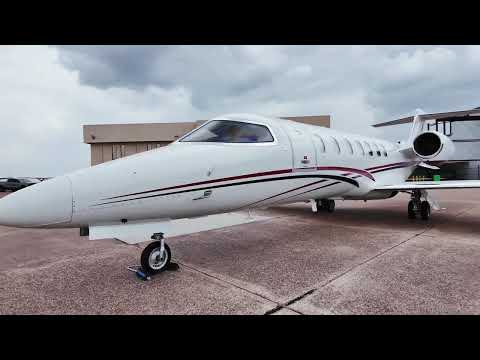
About the Learjet 70
Type certificated 2013
Overview
The Learjet 70 is a super-light business jet Bombardier introduced in 2013 as a modernised, short-fuselage development of the Learjet 40XR. Its Honeywell TFE731-40BR engines (3,850 lbf each, single-channel DEEC) and touchscreen Garmin G5000 Vision Flight Deck replaced the 40XR’s earlier powerplant and Pro Line panel, and canted winglets improve high-altitude cruise. It keeps the short cabin of the 40 on the family’s Mach 0.81, 51,000-foot performance profile, and Bombardier built it only from 2013 to 2017 before folding short-cabin demand into the longer Learjet 75.
Very few 70s were built, and that scarcity drives the buying decision more than any spec does. A shopper who wants the modern glass and the short, nimble airframe will spend longer finding a clean 70 than evaluating one, and will usually be pulled toward the Learjet 75 sitting next to it with a longer cabin, similar money, and a far deeper used market. Where the 70 wins is on its own terms: it is the only short-cabin Learjet that carries the modern G5000 panel and winglets, and for the rare buyer who wants that exact combination over a longer cabin, the thin inventory is the price of admission rather than a reason to walk.
Key Features for GA Buyers
- Speed and altitude. Mach 0.81 maximum cruise and a 51,000-foot service ceiling place the Lear 70 above most weather and commercial traffic.
- Avionics. The Garmin G5000 Vision Flight Deck is touchscreen-controlled and a substantial situational-awareness upgrade over the Pro Line equipment in legacy Learjets.
- Efficiency. Canted winglets and the -40BR’s aerodynamic refinements yield better fuel efficiency and climb performance than the Lear 40XR.
Trade-offs
- Cabin size. The 7-seat cabin is shorter than the Learjet 75’s 9-seat cabin and may feel tight at maximum occupancy.
- Market position. Production ran 2013 to 2017, a relatively short window before Bombardier focused on the Lear 75 alone, leaving used inventory scarcer than for the 75.
See Also
- Learjet 75 – Same airframe with a longer 9-seat cabin; the canonical sibling. Compare
- Learjet 45 – Direct platform predecessor; the 45XR was the donor airframe. Compare
- Learjet 40 – Same family, shorter fuselage and earlier engines. Compare
- Cessna Citation CJ4 – Direct light-jet competitor at a similar mission profile. Compare
- Embraer Phenom 300 – Best-selling light jet of the era; the Lear 70’s primary commercial rival. Compare
Technical Specifications
Dimensions & Weights
- Height
- 14 ft
- Length
- 56 ft
- Parking area (ft²2)
- 3,689 ft²
- Max Takeoff Weight
- 21,500 lbs
- Max Landing Weight
- 19,200 lbs
- Useful Load
- 7,610 lbs
- Fuel Capacity
- 905 gal
Performance
- Cruise Speed
- 465 KTAS
- Never-Exceed (VNE)
- Source: FAA Type Certificate Data Sheet 330 KIAS
- Max Structural Cruise (VNO)
- Source: FAA Type Certificate Data Sheet 330 KIAS
- Approach Speed
- 126 KIAS
- Stall, Clean (VS1)
- 97 KIAS
- Range
- 2060 NM
- Service Ceiling
- 51,000 ft
- Rate of Climb
- 4150 fpm
- Takeoff over 50 ft obstacle
- 4,230 ft
- Landing over 50 ft obstacle
- 2,660 ft
Engines
Log in to view or request powerplant data.
Sources
Where the figures on this page come from. Learjet 70 specifications are traced to published references; estimated values are flagged inline next to the figure.
Similar to the Learjet 70
Similar TurbofansIAI 1124 Westwind
Learjet 35/36
Learjet 55
Learjet 40
Dassault Falcon/Mystère 10
Gulfstream G150
Gulfstream G100
IAI Astra 1125
Learjet 75
Dassault Falcon/Mystère 20
Cessna Citation CJ2
Learjet 60
Cessna Citation CJ3
Embraer Phenom 300
Hawker 800XP
Learjet 31
Compare the Learjet 70 to other aircraft