Range Map
Origin: → · two fingers to move map
Payload vs. Range
Fuel on board
Cargo
nm
Range
Trip Preview
Name a destination in the map header above and this becomes your trip: time en route, what you burn, what it costs, and whether you get there without stopping — at the load you have set.
→
Over max payload by . At this load it cannot lift a single occupant. Please adjust your payload inputs.
We do not have a cruise speed on file for this aircraft, so there is no honest time or cost to give you for this leg.
En route
Fuel burned
Direct cost
Fuel cost
Tanks run dry about past before at this burn.
Mission Profile
- High-Altitude
- Pressurization
- Multi-Engine
- Instrument
_(2-24-2026).jpg)
Estimated Ownership Costs
Create a free account to view or request ownership cost data.
About the IAI 1124 Westwind
Type certificated 1976 Source: third-party reference
Overview
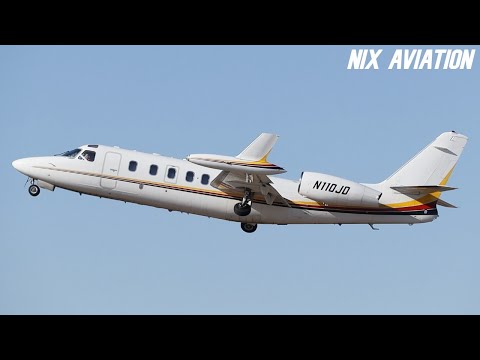
The IAI 1124 Westwind is one of the cheapest ways into a mid-size cabin jet, and its used-market price reflects both that appeal and the compromises behind it. Descended from the Aero Commander Jet Commander that IAI bought from Rockwell in 1968, the Westwind is a mid-wing twinjet with large tip tanks, powered by two 3,700 lbf Garrett TFE731-3 turbofans, cruising near 440 KTAS at up to 45,000 ft. The 1124 (Westwind I) and the winglet-equipped 1124A (Westwind II) share the type certificate; the II adds a new wing center-section, more fuel, and higher weights.
For a buyer, the Westwind trades refinement for value. It offers a flat-floor, stand-up mid-size cabin and roughly 2,200 nm of range for less than many turboprops cost, but it is heavy iron to fly, with manual (unpowered) flight controls and a real appetite for runway. It is a mission-first airplane, and its toughness made it a common choice for air-ambulance and maritime-patrol conversions.
Key Features for GA Buyers
- Low-cost mid-size cabin: a stand-up, flat-floor cabin and transcontinental-class range for an acquisition price often below a comparable turboprop.
- Standard APU: most 1124s carry a Microturbo Saphir APU for cabin climate and engine starting without ground power, unusual at this price.
- Special-mission pedigree: the tough airframe and large external baggage bay made the Westwind a frequent air-ambulance and patrol platform, so mission-equipped examples are readily found.
Trade-offs
- Runway-hungry: balanced field length often exceeds 5,000 ft, and hot-or-heavy departures need real planning.
- Manual flight controls: the Westwind uses unpowered cable-and-pulley controls, so it flies heavier than a modern light jet and asks more of the pilot.
- Legacy economics: the TFE731-3 pair burns around 240 gph and the type is old, so engine-program status is the single biggest value swing; an off-program airframe near an inspection carries large reserve risk.
See Also
- IAI Astra 1125 – IAI’s low-wing successor: faster and aerodynamically cleaner, with a narrower but taller cabin. Compare
- Learjet 35/36 – the archetypal TFE731 light-midsize of the same era: faster, with a tighter cabin. Compare
- Cessna Citation II – a slower, far easier-field alternative from the same used bracket. Compare
- Gulfstream G100 – where the lineage ended up: the Astra SPX under Gulfstream, a generation newer and better supported. Compare
Technical Specifications
Dimensions & Weights
- Height
- 16 ft
- Length
- 52 ft
- Parking area (ft²2)
- 3,140 ft²
- Max Takeoff Weight
- Source: third-party reference 22,850 lbs
- Max Landing Weight
- 19,000 lbs
- Useful Load
- 9,850 lbs
- Fuel Capacity
- 1,300 gal
Performance
- Cruise Speed
- Source: third-party reference 440 KTAS
- Approach Speed
- 120 KIAS
- Stall, Clean (VS1)
- 99 KIAS
- Range
- Source: third-party reference 2200 NM
- Service Ceiling
- Source: third-party reference 45,000 ft
- Rate of Climb
- 860 - 3200 fpm
- Takeoff over 50 ft obstacle
- 5,400 ft
- Landing over 50 ft obstacle
- 3,750 ft
Engines
Log in to view or request powerplant data.
Sources
Where the figures on this page come from. IAI 1124 Westwind specifications are traced to published references; estimated values are flagged inline next to the figure.
Similar to the IAI 1124 Westwind
Similar TurbofansLearjet 70
Learjet 55
IAI Astra 1125
Gulfstream G100
Learjet 40
Learjet 35/36
Dassault Falcon/Mystère 10
Learjet 60
Dassault Falcon/Mystère 20
Gulfstream G150
Hawker 800XP
Gulfstream G200
Compare the IAI 1124 Westwind to other aircraft