Range Map
Origin: → · two fingers to move map
Payload vs. Range
Fuel on board
Cargo
nm
Range
Trip Preview
Name a destination in the map header above and this becomes your trip: time en route, what you burn, what it costs, and whether you get there without stopping — at the load you have set.
→
Over max payload by . At this load it cannot lift a single occupant. Please adjust your payload inputs.
We do not have a cruise speed on file for this aircraft, so there is no honest time or cost to give you for this leg.
En route
Fuel burned
Direct cost
Fuel cost
Tanks run dry about past before at this burn.
Mission Profile
- High-Altitude
- Pressurization
- Multi-Engine
- Instrument
 (8-29-2022).jpg)
Estimated Ownership Costs
Create a free account to view or request ownership cost data.
About the Cessna Citation II
Type certificated 1978
Overview
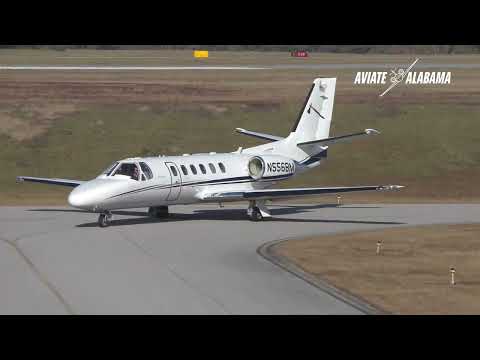
The Cessna Citation II (Model 550) is the stretched, higher-capacity development of the original Cessna Citation I. Introduced in 1978 and built through 1994, it lengthened the Model 500 fuselage for a true eight-seat cabin, fitted Pratt & Whitney Canada JT15D-4 turbofans of 2,500 lbf each, and raised cruise and ceiling while keeping the docile, short-field manners that made the Citation line a favorite of flight departments stepping up from cabin-class turboprops.
For the GA buyer, the Citation II is the value-volume light jet of the straight-wing family: a large in-service fleet gives it a deep parts and maintenance network, and handling forgiving enough for a first-jet transition, at a direct operating cost near 1,709 USD per hour. As with the rest of the JT15D family, engine overhaul economics dominate the ownership budget, so a clean engine status at pre-buy carries outsized weight.
Key Features for GA Buyers
- Deep support network. A large in-service fleet gives the Model 550 a broad pool of parts, maintenance expertise, and type-rated crews in the light-jet bracket.
- Short-field access. The straight wing lets a loaded Citation II operate from runways under 3,500 ft, reaching regional fields that swept-wing competitors clear only with a payload penalty.
- True eight-seat cabin. The stretch over the Citation I yields a genuine eight-passenger executive cabin with a stand-alone lavatory, a meaningful step up in usable capacity.
- Forgiving first-jet manners. Approach speeds near 100 KIAS and straightforward systems make the II an approachable owner-flown jet.
Trade-offs
- JT15D overhaul economics. The JT15D-4 turbofans are reliable and parts-supported, but a hot-section or full-overhaul event is a major capital cost; budget the reserve accordingly.
- Block speed. A max cruise near 385 KTAS is faster than the Citation I but still trails swept-wing competitors on longer legs, the enduring straight-wing trade.
- Two-pilot operation. The standard Model 550 is not single-pilot certificated; owner-operator economics must include a second pilot or contract crew. The Model 551 II/SP variant addresses this at reduced MTOW.
- First-generation avionics. Most Model 550s shipped with 1980s panels; expect to factor an avionics upgrade or accept legacy equipment in a pre-buy.
See Also
- Cessna Citation I – the original, shorter straight-wing Citation the II was stretched from; one cabin step down. Compare
- Cessna Citation Bravo – the 1997+ Model 550 successor re-engined with FADEC PW530A turbofans and a glass panel. Compare
- Cessna Citation V – the larger, faster Model 560 stretch one step up in the family. Compare
- Cessna Citation II/SP – the single-pilot-certificated Model 551 on the same airframe at reduced MTOW. Compare
Technical Specifications
Dimensions & Weights
- Height
- 15 ft
- Length
- 47 ft
- Parking area (ft²2)
- 3,253 ft²
- Max Takeoff Weight
- 15,100 lbs
- Max Landing Weight
- 13,500 lbs
- Useful Load
- 6,450 lbs
- Fuel Capacity
- Source: FAA Type Certificate Data Sheet 742 gal
Performance
- Cruise Speed
- 385 KTAS
- Never-Exceed (VNE)
- Source: FAA Type Certificate Data Sheet 260 KIAS
- Max Structural Cruise (VNO)
- Source: FAA Type Certificate Data Sheet 260 KIAS
- Approach Speed
- 99 KIAS
- Stall, Clean (VS1)
- 82 KIAS
- Range
- 1520 NM
- Service Ceiling
- 43,000 ft
- Rate of Climb
- 3040 fpm
- Takeoff over 50 ft obstacle
- 2,990 ft
- Landing over 50 ft obstacle
- 2,270 ft
Engines
Log in to view or request powerplant data.
Sources
Where the figures on this page come from. Cessna Citation II specifications are traced to published references; estimated values are flagged inline next to the figure.
Similar to the Cessna Citation II
Similar TurbofansCessna Citation V
Cessna Citation II/SP
Cessna Citation Bravo
Cessna Citation Encore
Cessna Citation Ultra
Pilatus PC-24
North American Rockwell Sabre 40/60
Compare the Cessna Citation II to other aircraft
External Media

Articles and other links
-
Wikipedia: Cessna Citation II en.wikipedia.org
-
Citation: A History - Textron Aviation cessna.txtav.com
-
Cessna Citation II Aircraft Description and Performance jetadvisors.com
-
GlobalAir: Citation II (550) Specifications www.globalair.com
-
SKYbrary: CESSNA 550 Citation 2 Data skybrary.aero
-
Turbine Pilot: Cessna Citation II (C-550) www.aopa.org