Range Map
Origin: → · two fingers to move map
Payload vs. Range
Fuel on board
Cargo
nm
Range
Trip Preview
Name a destination in the map header above and this becomes your trip: time en route, what you burn, what it costs, and whether you get there without stopping — at the load you have set.
→
Over max payload by . At this load it cannot lift a single occupant. Please adjust your payload inputs.
We do not have a cruise speed on file for this aircraft, so there is no honest time or cost to give you for this leg.
En route
Fuel burned
Direct cost
Fuel cost
Tanks run dry about past before at this burn.
Mission Profile
- High-Altitude
- Pressurization
- Multi-Engine
- Instrument

Estimated Ownership Costs
Create a free account to view or request ownership cost data.
About the Dassault Falcon/Mystère 50
Type certificated 1979 Source: FAA Type Certificate Data Sheet
Overview
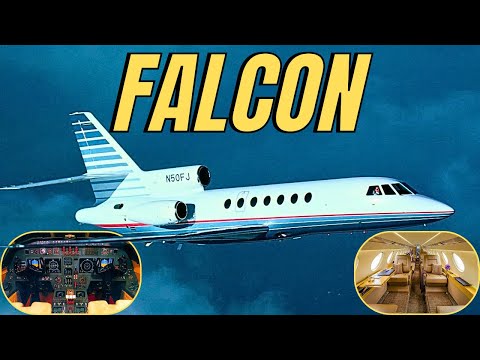
The Dassault Falcon 50 is a three-engine long-range business jet, first flown in 1976 and certificated in 1979. It was Dassault’s first purpose-built intercontinental Falcon and the first civil aircraft to fly a supercritical wing, pairing transatlantic reach with the trijet layout that became the family signature. Three Honeywell (originally Garrett) TFE731-3 turbofans feed through a center S-duct in the tail, giving the redundancy of a third engine on long overwater legs while keeping a midsize cabin cross-section. The dominant production form, about 252 of the 352 built, carries the TFE731-3-1C, certificates to 49,000 ft (serial 156 on), cruises near 468 knots, and flies roughly 3,000 to 3,100 nm with a typical nine-passenger cabin. The later Falcon 50EX (1996 to 2008) kept the airframe but moved to DEEC-controlled TFE731-40 engines and updated avionics, lifting range and field performance a step.
For a buyer, the Falcon 50 offers genuine transatlantic capability and three-engine reassurance at acquisition prices well below a purpose-built large-cabin jet, because the type is mature and out of production. The standing cost is operating complexity: a third engine to inspect and overhaul, and a fuel burn that reflects 1970s engine technology. Against a Cessna Citation X, the Falcon 50 concedes outright speed but answers with the overwater margin of a third engine and the field performance to use shorter runways; against a modern midsize such as the Cessna Citation Latitude, it trades current avionics and quieter, cheaper engines for longer legs and trijet redundancy at a fraction of the price. The Falcon 50 belongs with operators who cross water on a schedule and value a third engine for it; for trips that stay over land, a modern twin of similar cabin covers the same mission at a lower standing cost.
Key Features for GA Buyers
- Three-engine long-range capability. The trijet layout and supercritical wing give transatlantic range, roughly 3,000 to 3,100 nm in the base 50, with the dispatch reliability and overwater margin of a third engine, uncommon in this size class.
- Field performance for the cabin size. A sea-level balanced field length near 4,700 ft and landing distance around 2,150 ft let the Falcon 50 use airports that exclude many larger-cabin jets.
- Mature, well-supported airframe. Decades of fleet service and Dassault’s Falcon support network mean parts, training, and maintenance expertise are well established.
- High ceiling and fast cruise. A 49,000 ft ceiling (serial 156 on) clears most weather and traffic, and high-speed cruise near 468 knots keeps block times competitive.
Trade-offs
- Three engines to maintain. The center S-duct engine adds inspection, overhaul, and fuel-burn cost that twin-engine peers of similar cabin size do not carry.
- Older engine technology. The TFE731-3 is reliable but thirsty by modern standards; direct operating cost runs above newer super-midsize twins on a per-mile basis.
- Out of production. Residual values and parts pricing track an aging fleet, and pre-purchase inspection rigor matters, since early 50s differ from late EX airframes in weight, avionics, and engine standard.
- Two-crew requirement. Like its larger-cabin peers, the Falcon 50 is a two-pilot airplane, which raises crewing cost relative to owner-flown turbine singles and light jets.
See Also
- Dassault Falcon/Mystère 20 – Earlier Dassault Falcon twinjet, the original Mystère-Falcon line. Compare
- Dassault Falcon/Mystère 10 – Smaller Dassault Falcon sibling, the compact end of the family. Compare
- Cessna Citation X – Faster long-range super-midsize, but twin-engine. Compare
- Cessna Citation Latitude – Modern midsize cabin peer for buyers weighing range against newer systems. Compare
- Gulfstream G150 – Midsize long-range twinjet alternative at a similar mission profile. Compare
Technical Specifications
Dimensions & Weights
- Height
- 23 ft
- Length
- 61 ft
- Parking area (ft²2)
- 4,731 ft²
- Max Takeoff Weight
- Source: FAA Type Certificate Data Sheet 40,780 lbs
- Max Landing Weight
- 35,715 lbs
- Useful Load
- 17,900 lbs
- Fuel Capacity
- 2,315 gal
Performance
- Cruise Speed
- Source: third-party reference 468 KTAS
- Never-Exceed (VNE)
- Source: FAA Type Certificate Data Sheet 370 KIAS
- Max Structural Cruise (VNO)
- Source: FAA Type Certificate Data Sheet 370 KIAS
- Approach Speed
- 124 KIAS
- Stall, Clean (VS1)
- 95 KIAS
- Range
- Source: third-party reference 3057 NM
- Service Ceiling
- Source: FAA Type Certificate Data Sheet 49,000 ft
- Rate of Climb
- 3430 fpm
- Takeoff over 50 ft obstacle
- 4,935 ft
- Landing over 50 ft obstacle
- 2,159 ft
Engines
Log in to view or request powerplant data.
Sources
Where the figures on this page come from. Dassault Falcon/Mystère 50 specifications are traced to published references; estimated values are flagged inline next to the figure.
Compare the Dassault Falcon/Mystère 50 to other aircraft