Range Map
Origin: → · two fingers to move map
Payload vs. Range
Fuel on board
Cargo
nm
Range
Trip Preview
Name a destination in the map header above and this becomes your trip: time en route, what you burn, what it costs, and whether you get there without stopping — at the load you have set.
→
Over max payload by . At this load it cannot lift a single occupant. Please adjust your payload inputs.
We do not have a cruise speed on file for this aircraft, so there is no honest time or cost to give you for this leg.
En route
Fuel burned
Direct cost
Fuel cost
Tanks run dry about past before at this burn.
Mission Profile
- High-Altitude
- Pressurization
- Multi-Engine
- Instrument

Estimated Ownership Costs
Create a free account to view or request ownership cost data.
About the Cessna Citation X
Type certificated 1996 Source: FAA Type Certificate Data Sheet
Overview
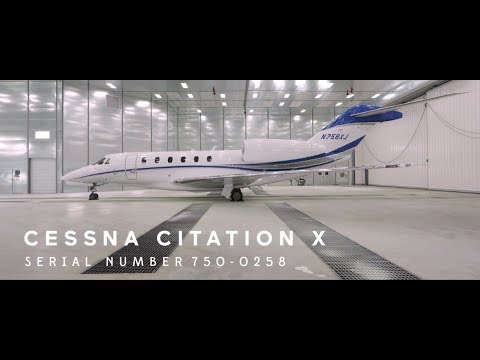
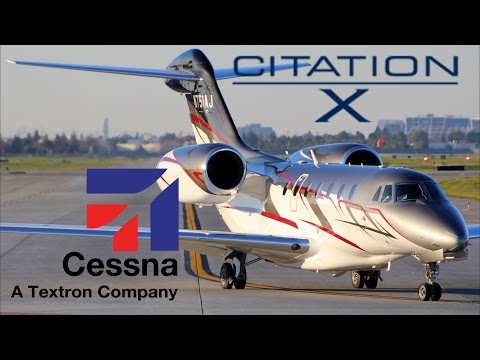
The Cessna Citation X (Model 750) is a super-midsize business jet built around speed. Its 37-degree swept wing and two Rolls-Royce AE3007C1 turbofans of 6,764 lbf each were engineered to cross the country quickly: certified to a 51,000 ft ceiling, it cruises at 525 kt near its Mach 0.92 limit, above almost all traffic and weather. The base Citation X flies on the AE3007C1; the later Citation X+ re-engined to the more powerful AE3007C2 and stretched the cabin.
For the owner stepping up from a light or midsize jet, the X is a genuine time machine: roughly 3,125 nm of range covers transcontinental and many transatlantic legs non-stop, and the high cruise speed turns long coast-to-coast legs into noticeably shorter days. That speed comes with a crew requirement and a fuel bill. The X carries a two-pilot minimum and a type rating, needs over 5,000 ft of runway, and burns about 386 gph for a roughly $4,736 hourly direct operating cost. Choose the Citation X when outright speed across long legs is the mission, you already operate with a professional two-pilot crew, and you accept higher fuel burn and a narrower cabin than a purpose-built wide-body super-midsize.
Key Features for GA Buyers
- High cruise speed: Cruises at 525 kt, near its Mach 0.92 limit, turning long transcontinental legs into shorter days.
- FL510 ceiling: Certified to 51,000 feet, it operates above commercial traffic and most weather.
- Transcontinental range: Roughly 3,125 nm, enough for coast-to-coast or many transatlantic missions non-stop.
- Hydraulic flight controls: Hydraulically powered primary controls with artificial feel give stable, predictable handling at high cruise speeds.
Trade-offs
- Operating cost: The Rolls-Royce AE3007 engines and complex hydraulics make the X expensive to run, about 386 gph and a roughly $4,736 hourly direct operating cost, well above the lighter Citations.
- Narrow cabin: It carries the Citation III fuselage cross-section, so the cabin is narrower than a purpose-built wide-body super-midsize and feels tight on long legs.
- Runway requirements: The highly swept wing raises approach speeds and needs over 5,000 feet of runway, well beyond the straight-wing Citations.
- Crewed operation: A two-pilot minimum crew and type rating put it above the owner-flown CitationJet tier in cost and training commitment.
See Also
- Cessna Citation Sovereign – Cessna’s straight-wing super-midsize: more cabin, less speed. Compare
- Cessna Citation Longitude – the modern super-midsize Citation flagship. Compare
- Cessna Citation Latitude – midsize Citation built around cabin comfort over outright speed. Compare
- Gulfstream G280 – super-midsize rival with a wider cabin and comparable range. Compare
- Bombardier Challenger 350 – the dominant super-midsize competitor. Compare
- Cessna Citation CJ4 – the owner-flown single-pilot step down within the Citation line. Compare
Technical Specifications
Dimensions & Weights
- Height
- 19 ft
- Length
- 72 ft
- Parking area (ft²2)
- 6,122 ft²
- Max Takeoff Weight
- 36,100 lbs
- Max Landing Weight
- 31,800 lbs
- Useful Load
- 14,075 lbs
- Fuel Capacity
- 1,930 gal
Performance
- Cruise Speed
- 525 KTAS
- Never-Exceed (VNE)
- Source: FAA Type Certificate Data Sheet 350 KIAS
- Max Structural Cruise (VNO)
- Source: FAA Type Certificate Data Sheet 270 KIAS
- Approach Speed
- 112 KIAS
- Stall, Clean (VS1)
- 114 KIAS
- Range
- 3125 NM
- Service Ceiling
- 51,000 ft
- Rate of Climb
- 1120 - 3650 fpm
- Takeoff over 50 ft obstacle
- 5,140 ft
- Landing over 50 ft obstacle
- 2,730 ft
Engines
Log in to view or request powerplant data.
Sources
Where the figures on this page come from. Cessna Citation X specifications are traced to published references; estimated values are flagged inline next to the figure.
Similar to the Cessna Citation X
Similar TurbofansCessna Citation Longitude
Embraer Legacy 500
Cessna Citation Sovereign
Embraer Praetor 600
Embraer Praetor 600E
Compare the Cessna Citation X to other aircraft