Bombardier Learjet 23
Jet • twin engine • Low Wing • Retractable gear
Range Visualization
Origin: · click map to move · nm at current load
Payload vs. Range
Customize assumptions
Default: 190 lbs (FAA standard)
Default: 30 lbs
Mission Profile
- High-Altitude
- Pressurization
- Multi-Engine
- Instrument
About the Bombardier Learjet 23
Overview
The Bombardier Learjet 23 is the genesis of the private jet industry. Introduced in 1964 and designed by Bill Lear’s team using elements adapted from the Swiss FFA P-16 ground-attack fighter, the original Learjet brought fighter-class climb and cruise speed to the civilian market for the first time. 104 airframes were built between 1964 and 1966 before production transitioned to the refined Learjet 24; the type was certificated for two-pilot operation only and powered by twin General Electric CJ610 turbojets, with fuel carried in the iconic wing-tip tanks.
For the GA buyer today, a Learjet 23 is a collector aircraft, not a working business jet. Stage 2 noise restrictions effectively bar the type from many US and European fields without expensive hush-kit modifications, parts support is sparse after sixty-plus years, and the demanding low-speed handling places it well outside any entry-level jet bracket. The realistic audience is vintage-jet operators, restoration projects, and the small set of charter operators that can build a story around an original Learjet. For buyers drawn to the same identity in a more current package, the Learjet 25 is the volume sibling on the same CJ610 platform and the Learjet 31 is the modern hot-rod descendant.
Key Features for GA Buyers
- Rocket-like performance. With a power-to-weight ratio approaching that of fighter aircraft, the Lear 23 boasts an initial climb rate of 6,900 fpm. It can reach 40,000 ft in under 10 minutes.
- Vintage appeal. Owning a Lear 23 is owning a classic. It attracts attention on any ramp due to its history and distinctive tip tanks.
- Entry price. While operating costs are high, the acquisition cost of these vintage airframes can be surprisingly low compared to modern jets.
Trade-offs
- Noise restrictions. The General Electric CJ610 turbojets are extremely loud (Stage 2). Without expensive “hush kits,” this aircraft is banned from operating at many airports in the US and Europe.
- Pilot workload. The Lear 23 is a two-pilot aircraft known for demanding handling characteristics, particularly at low speeds. It has a high accident rate historically due to its unforgiving nature.
- Range and comfort. The cabin is very small (you cannot stand up), and while fast, the range is limited to approximately 1,500 nm, necessitating fuel stops for cross-country trips.
- Maintenance. Parts scarcity and the age of the airframe (60+ years) make maintenance a challenge for the faint of heart.
See Also
- Learjet 24 – the immediate successor with refined certification and minor airframe improvements. Compare
- Bombardier Learjet 25 – the stretched ten-seat variant that became the volume seller of the CJ610 era. Compare
- Bombardier Learjet 35/36 – the TFE731 turbofan modernization that succeeded the original CJ610 line. Compare
- Bombardier Learjet 31 – the modern hot-rod descendant with TFE731-2 turbofans and 51,000 ft ceiling. Compare
Technical Specifications
Dimensions
- Wingspan
- 35.6 ft
- Length
- 43.3 ft
- Height
- 12.6 ft
- Parking area (ft2)
- 2202.48 ft2
Weights
- Max Takeoff Weight
- 12,500 lbs
- Max Landing Weight
- 11,880 lbs
- Useful Load
- 6,350 lbs
- Fuel Capacity
- 847 gal
Performance
- Cruise Speed
- 450 KTAS
- Never-Exceed (Vne)
- 462 KIAS
- Max Structural Cruise (Vno)
- 300 KIAS
- Approach Speed
- 128 KIAS
- Stall, Clean (Vs1)
- 90 KIAS
- Range
- 1590 NM
- Service Ceiling
- 45,000 ft
- Rate of Climb
- 6900 fpm
- Takeoff over 50 ft obstacle
- 3,393 ft
- Landing ground roll
- 3,310 ft
Similar to the Bombardier Learjet 23

Cessna Citation V/Ultra/Encore
Bombardier Learjet 25
Bombardier Learjet 31
Learjet 70
Cessna Citation CJ2
Cessna Citation M2
Learjet 40
Cessna Citation CJ3
See how the Bombardier Learjet 23 stacks up against similar aircraft
External Media
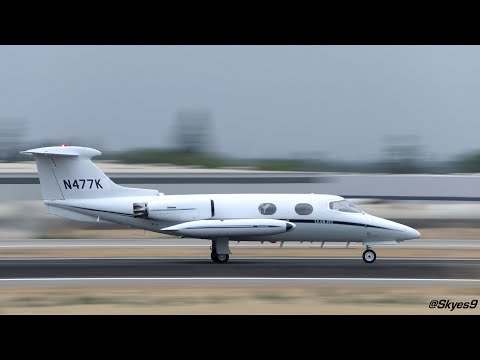

Image Galleries
Other Links
-
Learjet 23 - Wikipedia en.wikipedia.org
-
Lear Jet 23 | National Air and Space Museum airandspace.si.edu
-
Challenge Accepted: Restoring Learjet 23-003 - FLYING Magazine www.flyingmag.com
-
Bizjet pioneers - AOPA www.aopa.org
-
LEARJET 23 Specifications, Performance, and Range - Globalair.com www.globalair.com
-
Learjet Model 23 - Pima Air & Space Museum pimaair.org