Range Map
Origin: → · two fingers to move map
Payload vs. Range
Fuel on board
Cargo
nm
Range
Trip Preview
Name a destination in the map header above and this becomes your trip: time en route, what you burn, what it costs, and whether you get there without stopping — at the load you have set.
→
Over max payload by . At this load it cannot lift a single occupant. Please adjust your payload inputs.
We do not have a cruise speed on file for this aircraft, so there is no honest time or cost to give you for this leg.
En route
Fuel burned
Direct cost
Fuel cost
Tanks run dry about past before at this burn.
Mission Profile
- High-Altitude
- Pressurization
- Multi-Engine
- Instrument
.jpg)
Estimated Ownership Costs
Create a free account to view or request ownership cost data.
About the Learjet 24
Type certificated 1966 Source: FAA Type Certificate Data Sheet
Overview
The Learjet 24 is the heavier-gross-weight refinement of the original Lear Jet line: a Part 25 transport-category development of the Learjet 23 that kept the fighter-bred airframe and twin General Electric CJ610 turbojets while raising takeoff weight, certified ceiling, and structural margins. Built from 1966, the 24 carries eight occupants behind the same slender, tip-tanked wing that defined the early Learjet silhouette; the stretched Learjet 25 followed in 1967. Around 260 were produced across the 24/24A through 24F variants before the line gave way to the TFE731-powered Learjet 35/36.
For the GA buyer, the Learjet 24 is caught between a purer collectible and a more practical stretch. Against the Learjet 23 it gains higher gross weight, a 45,000 ft certified ceiling, and a more refined certification basis, but gives up the 23’s standing as the genuine first-of-its-kind original that vintage collectors prize. Against the stretched Learjet 25 it concedes two seats and several feet of cabin for no meaningful gain in speed or economy, which is why many shoppers comparing the two on equal-condition airframes favor the 25. What pins the 24 to a narrow audience is the operating reality every CJ610 Learjet shares: Stage 2 noise that bars unmodified airframes from many fields, fuel burn no modern light jet approaches, and out-of-pocket engine overhauls with no hourly program to smooth them.
Key Features for GA Buyers
- Fighter-class climb and altitude. A climb rate near 6,800 fpm and a 45,000 ft certified ceiling let the Lear 24 leave weather and airline traffic below it.
- Speed at a vintage price. A high-speed cruise near 440 knots in an airframe that trades at a fraction of any modern light jet’s acquisition cost.
- Pilot’s-airplane heritage. Direct, mechanical handling and the classic tip-tanked Learjet silhouette, a flying experience newer designs deliberately engineer away.
Trade-offs
- Stage 2 noise. The CJ610 turbojets are loud enough that unmodified aircraft are barred from many U.S. and European airports; a Stage 3 hush kit (around $125,000) is often required for practical access.
- Thirsty turbojets. At roughly 257 gallons/hour the pure turbojets burn far more than any modern turbofan, and there is no engine-program structure to cap overhaul exposure.
- Two-pilot, high-workload jet. The 24 is two-pilot certificated and demands current jet skills; it is not an entry-level or owner-flown type.
- Out-of-pocket maintenance. A sixty-year-old airframe with no hourly engine program means overhauls and 12-year inspections land as large, lumpy bills rather than predictable reserves.
See Also
- Learjet 23 – the original first-generation Learjet the 24 was developed from, lighter and certified under CAR Part 3. Compare
- Learjet 25 – the stretched ten-seat sibling on the same CJ610 platform, usually the more practical buy. Compare
- Learjet 35/36 – the TFE731 turbofan modernisation that replaced the CJ610 line with Stage 3 compliance and longer range. Compare
- Learjet 31 – the modern hot-rod descendant with TFE731-2 turbofans and a 51,000 ft ceiling. Compare
Technical Specifications
Dimensions & Weights
- Height
- 12 ft
- Length
- 43 ft
- Parking area (ft²2)
- 2,200 ft²
- Max Takeoff Weight
- 13,500 lbs
- Max Landing Weight
- 11,880 lbs
- Useful Load
- 6,160 lbs
- Fuel Capacity
- 840 gal
Performance
- Cruise Speed
- 439 KTAS
- Never-Exceed (VNE)
- Source: FAA Type Certificate Data Sheet 300 KIAS
- Max Structural Cruise (VNO)
- Source: FAA Type Certificate Data Sheet 300 KIAS
- Approach Speed
- 125 KIAS
- Stall, Clean (VS1)
- 106 KIAS
- Range
- 1100 NM
- Service Ceiling
- Source: FAA Type Certificate Data Sheet 45,000 ft
- Rate of Climb
- 6800 fpm
- Takeoff over 50 ft obstacle
- 3,300 ft
- Landing over 50 ft obstacle
- 2,450 ft
Engines
Log in to view or request powerplant data.
Sources
Where the figures on this page come from. Learjet 24 specifications are traced to published references; estimated values are flagged inline next to the figure.
Similar to the Learjet 24
Similar TurbojetsLearjet 23
Learjet 25
Hawker Beechcraft Premier IA
Compare the Learjet 24 to other aircraft
External Media



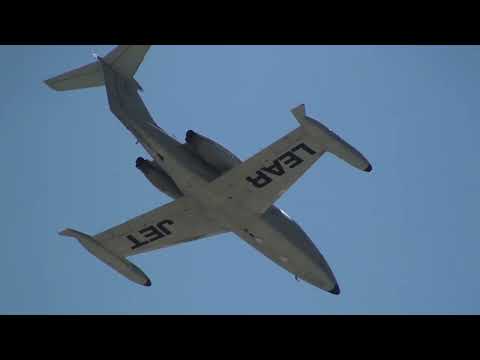
Image Galleries
Articles and other links
-
Learjet 24 - Wikipedia en.wikipedia.org
-
Pilot Report: Lear Jet 24 - AOPA (Archived PDF) d16bsf97ryvc45.cloudfront.net
-
Flying the Learjet 24D - Budd Davisson (Airbum.com) www.airbum.com
-
50 Years of Learjets - FLYING Magazine www.flyingmag.com
-
Gates Learjet 24F Specs and Description - Premier Jet Aviation jetav.com
-
Learjet 24: NASA's Airborne Observatory – MotoArt PlaneTags planetags.com