Range Map
Origin: → · two fingers to move map
Payload vs. Range
Fuel on board
Cargo
nm
Range
Trip Preview
Name a destination in the map header above and this becomes your trip: time en route, what you burn, what it costs, and whether you get there without stopping — at the load you have set.
→
Over max payload by . At this load it cannot lift a single occupant. Please adjust your payload inputs.
We do not have a cruise speed on file for this aircraft, so there is no honest time or cost to give you for this leg.
En route
Fuel burned
Direct cost
Fuel cost
Tanks run dry about past before at this burn.
Mission Profile
- High-Performance
.jpg)
Estimated Ownership Costs
Create a free account to view or request ownership cost data.
About the Van's RV-10
Overview
The Van’s RV-10 is a four-seat, single-engine, low-wing Experimental Amateur-Built kit aircraft from Van’s Aircraft of Aurora, Oregon. First flown in 2003, it was Van’s first design conceived from the outset as a true four-place cross-country traveler rather than a stretched two-seat sportplane, and with roughly 1,000-plus airframes flying it is one of the most-built four-seat kits in general aviation. Built around the six-cylinder 260 hp Lycoming O-540 / IO-540, it cruises about 171 KTAS at 75% power, climbs at 1,450 fpm, and carries four adults with full fuel and baggage behind upward-swinging gull-wing doors.
Among four-seat travelers the RV-10 occupies an unusual niche: it matches the speed of a certified Cirrus SR22 and outruns fixed-gear singles like the Cessna 182 and Diamond DA40, at a fraction of their acquisition cost, but only for a builder willing to invest the hours and accept experimental status. It carries no factory parachute, so whole-airframe-recovery-minded buyers land on Cirrus instead. Choose the Van’s RV-10 when you want SR22-class four-seat cross-country performance on a builder’s budget, value owner-maintenance and the kit-build path, and do not require a type certificate or a factory parachute.
Key Features for GA Buyers
- True four-adult cabin. Van’s designed the cabin around 6‘4” front and rear occupants with comfortable leg and head room, full fuel, and 60 lb of baggage. This is the design center, not a marketing claim, and it is the reason the RV-10 stands apart from the smaller RV-7 and RV-9.
- Cross-country performance with fixed gear. 171 KTAS cruise on 260 hp at 8,000 ft puts the RV-10 in the same speed band as the Cirrus SR22 and ahead of fixed-gear certified four-seaters like the Cessna 182 and Diamond DA40, all without the cost or complexity of retractable gear.
- Lycoming O-540 / IO-540 powerplant. The airframe is matched to the six-cylinder parallel-valve O-540 family, a direct-drive, air-cooled engine with a 2,000-hour published TBO and broad parts support. Most builders fit the fuel-injected IO-540 variant proven on the prototype.
- Builder-controlled maintenance. Under the Repairman Certificate the original builder may perform the annual condition inspection and most maintenance, which materially compresses ownership operating cost relative to a certified four-seater.
- Gull-wing cabin doors. Both doors swing upward, giving all four seats independent access without climbing over a wing or shuffling past a front-seat occupant.
Trade-offs
- Amateur-built means builder responsibility. The RV-10 ships as a kit, not a finished airplane. Build times vary widely (1,500 to 3,000 hours is typical) and the as-flown quality, weight, and equipment depend entirely on the builder. Used-market valuation tracks builder reputation, not just airframe hours.
- No type certificate, no IFR-by-default. Each experimental certificate carries its own operating limitations. IFR privileges, night privileges, and equipment requirements are negotiated airframe by airframe with the FAA inspector or DAR, and certain commercial operations are categorically excluded.
- No factory parachute system. Unlike the Cirrus SR-series, the RV-10 has no manufacturer-installed airframe parachute. Buyers who weight whole-airframe recovery heavily will land on Cirrus.
- Insurance and financing friction. Experimental amateur-built status narrows the insurance market and complicates traditional aircraft financing relative to a certified airplane in the same speed and seating class.
- Resale tied to airframe identity, not type. Two RV-10s with identical hours can differ materially in value based on build quality, panel, paint, and the original builder’s reputation. The buyer is acquiring a specific airplane, not a generic instance of a type.
See Also
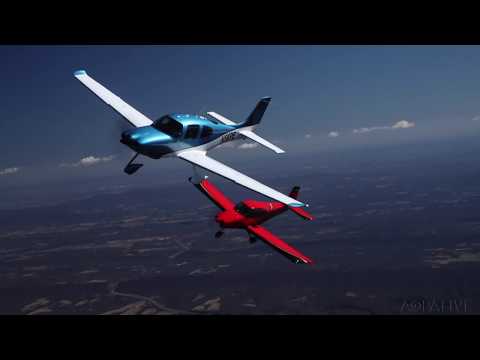
- Cirrus SR22 – direct certified competitor in the four-seat, 170+ KTAS, 260+ hp cross-country single bracket; AOPA’s 2020 fly-off ran the two head to head. Compare
- Diamond DA40 – certified four-seat fixed-gear single often cross-shopped on the lower end of the cabin and performance band. Compare
- Van’s RV-14 – two-seat sibling kit from Van’s, the natural step-down for builders who do not need four seats. Compare
- Cessna 182 Skylane – certified four-seat traveling single; AOPA’s second fly-off pitted the two as the experimental-versus-legacy four-seater comparison. Compare
- Sling TSi – a Rotax-powered four-seat kit cross-shop, the lighter and cheaper-to-run alternative for builders who do not need the RV-10’s speed and cabin. Compare
Technical Specifications
Dimensions & Weights
- Height
- 9 ft
- Length
- 24 ft
- Parking area (ft²2)
- 1,228 ft²
- Max Takeoff Weight
- 2,700 lbs
- Max Landing Weight
- 2,700 lbs
- Useful Load
- 1,070 lbs
- Fuel Capacity
- 60 gal
Performance
- Cruise Speed
- Source: third-party reference 171 KTAS
- Never-Exceed (VNE)
- Source: manufacturer figure 200 KIAS
- Approach Speed
- 70 KIAS
- Stall, Clean (VS1)
- 55 KIAS
- Range
- 717 NM
- Service Ceiling
- 20,000 ft
- Rate of Climb
- 1450 fpm
Engine
Log in to view or request powerplant data.
Sources
Where the figures on this page come from. Van's RV-10 specifications are traced to published references; estimated values are flagged inline next to the figure.
Similar to the Van's RV-10
Similar PistonsTecnam P2010 215 HP
Cessna 182T Skylane
Piper Cherokee 235
Lancair LC-40 Columbia 300
Cirrus SR20
Cirrus SR22
Compare the Van's RV-10 to other aircraft
External Media

Articles and other links
-
RV-10 -- Van's Aircraft (official spec page) www.vansaircraft.com
-
Van's Aircraft RV-10 (Wikipedia) en.wikipedia.org
-
Fly-off: RV-10 versus SR22 (AOPA Pilot, June 2020) www.aopa.org
-
-
Tim's Unofficial RV-10 FAQ www.myrv10.com
-
RV-10 forum (Van's Air Force) vansairforce.net