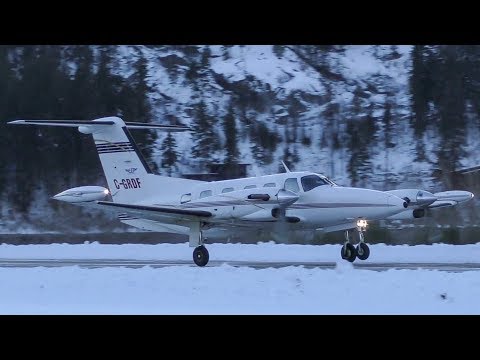
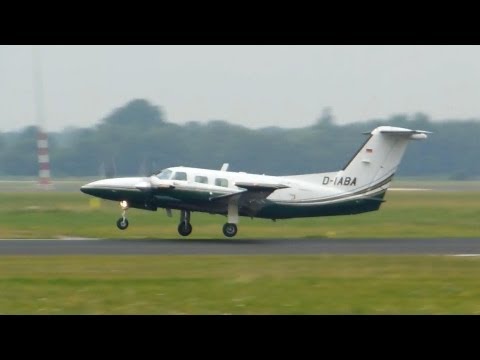
Piper PA-42 Cheyenne III
Turboprop twin engine • Low Wing • Retractable gear
Range Map
• nm at current load
• click map to move • two fingers to move map
Payload vs. Range
Configure weights
Default: 190 lbs
Default: 30 lbs
gal
Fuel on board
lbs
Extra weight
nm
Range
Mission Profile
- High-Performance
- Complex
- High-Altitude
- Pressurization
- Multi-Engine
- Instrument
Estimated Ownership Costs
About the Piper PA-42 Cheyenne III
Type certificated 1979
Overview
The Piper PA-42 Cheyenne III is the larger, T-tailed evolution of the Cheyenne family, designed specifically to compete with the Beechcraft King Air 200 in the mid-size cabin-class turboprop segment. Five feet longer than the PA-31T Cheyenne II and powered by two 720 shp Pratt & Whitney Canada PT6A-41 engines, it does not share the short-coupled handling concerns of its predecessor: the T-tail keeps the horizontal stabilizer out of the propwash and removes the need for the Stability Augmentation System.
The III cruises around 290 knots at low altitude and 270 at FL290, with practical range of roughly 1,300 nm at typical cruise. The Cheyenne IIIA (the PA-42-720), which followed in 1983, swapped to PT6A-61 engines, raised the service ceiling to 35,000 ft, and modestly improved cruise speed and range. Production totalled 89 IIIs and 60 IIIAs across the 1980 to 1991 window, with roughly 71 still on the FAA registry.
The Cheyenne III’s reputation in the used market is shaped by its relative scarcity. Direct Beechcraft King Air competitors hold value better and have a denser support network, but examples in the $1.0 to $1.5 million range with modern panels offer one of the lower-cost paths into a true cabin-class, FL330-capable turboprop. Owners and brokers consistently note maintenance costs running roughly $50 to $100 per hour below comparable King Airs.
Key Features for GA Buyers
- T-tail handling. The horizontal stabilizer is removed from the propwash and wing wake. Pitch authority is conventional and SAS is not required, in contrast to the short-coupled Cheyenne II.
- High-altitude cabin. 6.3 psi pressurization differential maintains a sea-level cabin altitude up to 14,600 ft and a comfortable cabin altitude in the low 30s.
- Cabin capacity. Up to 11 occupants certificated, typically two pilots plus seven passengers in a club layout, with notable cabin width relative to a King Air 90 or Cheyenne II.
- PT6A-41 economics. 720 shp per side at a published cruise fuel flow around 82 GPH, giving the Cheyenne III competitive economics for the cabin class.
Trade-offs
- Runway requirements. 11,200 lb MTOW and higher wing loading mean takeoff over a 50-foot obstacle requires roughly 3,200 ft at gross weight. Less of a short-field performer than the Cheyenne I or II.
- Smaller installed base. 89 IIIs plus 60 IIIAs built. Parts are generally available but the network of shops with deep PA-42 expertise is smaller than the King Air support ecosystem.
- Engine TBO. PT6A-41 is rated at 3,000 hr TBO, lower than the PT6A-11 and PT6A-28 used on the smaller Cheyennes. Factor the more frequent overhaul interval into reserve planning.
- Bleed-air HVAC. Cabin heating and cooling rely on engine bleed air. Both heat and cooling lag on initial start until at least one engine has been running.
See Also
- Piper Cheyenne 400 – top-of-range Cheyenne with Garrett TPE331 engines, faster cruise, and higher ceiling. Compare
- Piper Cheyenne II – shorter, lighter PT6A-28 sibling with mandatory SAS but lower acquisition cost. Compare
- Beech Super King Air 350 – the long-running King Air competitor at the mid-size cabin-class step. Compare
- Beech King Air 100 – mid-cabin King Air that overlaps the Cheyenne III’s market position. Compare
- Cessna Conquest II – contemporary cabin-class twin turboprop direct competitor. Compare
Technical Specifications
Dimensions & Weights
- Height
- 14.75 ft
- Length
- 43.39 ft
- Parking area (ft2)
- 2790.65 ft2
- Max Takeoff Weight
- 11,200 lbs
- Max Landing Weight
- 10,330 lbs
- Useful Load
- 4,363 lbs
- Fuel Capacity
- 562 gal
Performance
- Cruise Speed
- 290 KTAS
- Never-Exceed (VNE)
- Source: FAA Type Certificate Data Sheet 245 KIAS
- Max Structural Cruise (VNO)
- Source: FAA Type Certificate Data Sheet 245 KIAS
- Approach Speed
- 105 KIAS
- Stall, Clean (VS1)
- 89 KIAS
- Range
- 1550 NM
- Service Ceiling
- 33,000 ft
- Rate of Climb
- 531 - 2236 fpm
- Takeoff over 50 ft obstacle
- 3,230 ft
- Landing ground roll
- 2,554 ft
Sources
Where the figures on this page come from. Piper PA-42 Cheyenne III specifications are traced to published references; estimated values are flagged inline next to the figure.
Similar to the Piper PA-42 Cheyenne III
Similar TurbopropsBeech 1900/C-12J
Beech 200 Super King
Beech King Air 100
See how the Piper PA-42 Cheyenne III stacks up against similar aircraft
External Media

Articles and other links
-
AOPA Pilot - Quick Look: Cheyenne III and IIIA www.aopa.org
-
JetAv - Piper Cheyenne III/IIIA Performance Specifications jetav.com
-
Flugzeuginfo - Piper PA-42 Cheyenne III Technical Data www.flugzeuginfo.net
-
Wikipedia - Piper PA-42 Cheyenne en.wikipedia.org
-
Business Jet Traveler - Piper Cheyenne III & IIIA www.bjtonline.com
Report an inaccuracy
Spotted something wrong in the section? Tell us what's off and we'll review it.