Pelegrin Tarragon
Piston single engine • Low Wing • Retractable gear
Range Visualization
· nm at current load
· click map to move · two fingers to move map
Payload vs. Range
Configure weights
Default: 190 lbs
Default: 30 lbs
Fuel on board
Extra weight
Range
Mission Profile
- • Complex
About the Pelegrin Tarragon
Overview
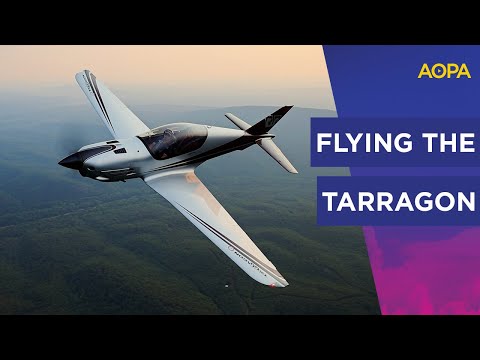
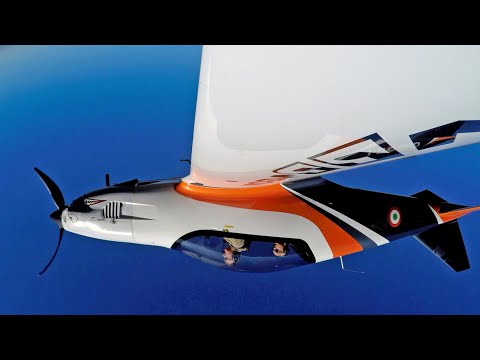
The Pelegrin Tarragon is a two-seat, full carbon-fiber, retractable-gear light aircraft built in Riga, Latvia, and sold in the United States under the Tarragon Aircraft brand. It is one of the fastest aircraft in its weight class: on the 160-horsepower turbocharged Rotax 916 iS it cruises around 170 knots true while burning automotive fuel. It carries a ballistic recovery parachute, a constant-speed propeller, and electrically retractable tricycle gear. The airframe is laid up from pre-preg carbon fiber and cured in an autoclave, and the one-piece panoramic canopy gives glider-like visibility from both seats.
In the United States the Tarragon does not fit the legacy Light Sport rules: its retractable gear, constant-speed prop, and 170-knot cruise all sit beyond the old LSA limits. It is instead a MOSAIC aircraft, and MOSAIC arrives in two phases. The FAA’s 2025 Modernization of Special Airworthiness Certification rule expanded sport-pilot privileges, effective October 22, 2025, to cover retractable-gear and constant-speed-propeller aircraft like the Tarragon for pilots who hold the matching endorsements. The separate provisions that let it be sold in the US as a finished, factory-built Special LSA take effect July 24, 2026, and depend on new ASTM consensus standards still being finalized. Buyers cross-shop it against the Porto Aviation Risen, the Blackshape Prime, and the JMB VL3, the small cohort of European carbon-fiber retractable speedsters, and against the experimental Sling TSi for buyers who want the same Rotax 916 efficiency in a four-seat homebuilt.
Key Features for GA Buyers
- Speed on automotive fuel. The turbocharged Rotax 916 iS holds power to altitude and returns roughly 170 knots cruise on mogas.
- Carbon airframe with a ballistic parachute. The autoclave-cured pre-preg structure is light and stiff, and whole-aircraft parachute recovery is standard equipment, not an option.
- Retractable gear and a constant-speed prop in a light airframe. Both remain available to sport pilots under MOSAIC, provided they hold the matching retractable-gear and constant-speed-propeller endorsements.
- A cabin built for tall pilots. The sculpted cockpit and tall canopy give unusual head and shoulder room for the class, which keeps the Tarragon comfortable on long cross-country legs despite its small footprint.
Trade-offs
- MOSAIC category, not legacy LSA. The Tarragon reaches the US under the FAA’s 2025 MOSAIC framework rather than the older Light Sport category, so its registration path and US resale market are newer and less settled than for an established type.
- Two seats and modest baggage. This is a fast tourer for one or two people, not a family airplane; useful load is about 720 pounds and baggage is limited to roughly 80 pounds.
- Complex-aircraft workload and cost. Retractable gear and a constant-speed propeller add inspection items, maintenance, and insurance cost that a fixed-gear, fixed-pitch trainer never carries, and qualified type-specific maintenance is still thin across North America.
- A premium price for the category. A factory-built Rotax 916 Tarragon is priced around $420,000, which is high-performance-single money for a two-seat airframe.
See Also
- Porto Aviation Risen – the closest competitor, an Italian carbon-fiber retractable also built around the Rotax 916, for buyers comparing the two fastest mogas two-seaters. Compare
- Blackshape Prime – an Italian carbon-fiber two-seat retractable with a military-trainer look, cross-shopped for the same speed-and-style brief. Compare
- JMB VL3 – a Czech carbon-fiber retractable speedster in the same MOSAIC-bound class. Compare
- Sling TSi – the four-seat experimental homebuilt on the same Rotax 916 iS, for buyers who want carrying capacity over outright speed. Compare
Technical Specifications
Dimensions & Weights
- Height
- 8.17 ft
- Length
- 24.67 ft
- Parking area (ft2)
- 1070.49 ft2
- Max Takeoff Weight
- Source: third-party reference 1,650 lbs
- Max Landing Weight
- 1,650 lbs
- Useful Load
- 720 lbs
- Fuel Capacity
- Source: third-party reference 42 gal
Performance
- Cruise Speed
- Source: third-party reference 170 KTAS
- Never-Exceed (Vne)
- Source: third-party reference 200 KIAS
- Approach Speed
- 71 KIAS
- Stall, Clean (Vs1)
- Source: third-party reference 54 KIAS
- Range
- 1025 NM
Sources
Where the figures on this page come from. Pelegrin Tarragon specifications are traced to published references; estimated values are flagged inline next to the figure.
Similar to the Pelegrin Tarragon
Similar PistonsAero Commander 200
Beech 24 Sierra
Beech Bonanza 33
See how the Pelegrin Tarragon stacks up against similar aircraft