Range Map
Origin: → · two fingers to move map
Payload vs. Range
Fuel on board
Cargo
nm
Range
Trip Preview
Name a destination in the map header above and this becomes your trip: time en route, what you burn, what it costs, and whether you get there without stopping — at the load you have set.
→
Over max payload by . At this load it cannot lift a single occupant. Please adjust your payload inputs.
We do not have a cruise speed on file for this aircraft, so there is no honest time or cost to give you for this leg.
En route
Fuel burned
Direct cost
Fuel cost
Tanks run dry about past before at this burn.
Mission Profile
_06.jpg)
Estimated Ownership Costs
Create a free account to view or request ownership cost data.
About the Grumman American AA1
Type certificated 1967 Source: FAA Type Certificate Data Sheet
Overview
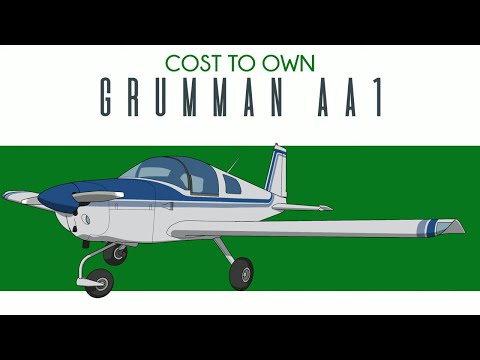
The Grumman American AA-1 Yankee is a two-seat, fixed-gear, low-wing single produced from 1968 to 1978, the airplane that launched the bonded-aluminum Grumman light-aircraft line. Designed by Jim Bede as the BD-1 and certified by American Aviation, it pairs a rivet-free metal-bonded structure and a sliding canopy with a 108 hp Lycoming O-235, and earned a reputation as the sports car of two-seaters, faster and far more responsive than the Cessna and Piper trainers it competed with. The family runs from the original AA-1 Yankee through the AA-1A and AA-1B Trainer and TR-2 to the final AA-1C T-Cat and Lynx, the last of which moved to the 115 hp O-235-L2C.
The Yankee suits a pilot who already understands its tradeoffs and wants the speed and the sliding canopy anyway. It is not a primary trainer and it is not a four-seater: a Cessna 150 is friendlier for learning, and the Grumman Cheetah adds two seats and real range for not much more money. Its slick wing also carries a higher stall and steeper sink than those trainers, which is why it demands speed discipline on final and sits just outside sport-pilot eligibility. Bought clear-eyed as a low-cost sport two-seater, though, few airplanes return more fun per dollar.
Key Features for GA Buyers
- Speed and responsiveness. Noticeably faster than a Cessna 150 or 152 on comparable power, with a high roll rate and light, sporty controls that owners prize.
- Bubble canopy. The sliding canopy gives near-360-degree visibility and slides open on the ground for hot-day taxi.
- Low-drag bonded airframe. The rivet-free metal-bonded structure is clean, simple, and easy to keep.
- Low cost of ownership. A small O-235, simple systems, and an active owner community keep direct operating costs at the lower end of certificated two-seat singles.
Trade-offs
- A demanding wing. The AA-1’s airfoil stalls higher and sinks faster than a typical trainer’s; let speed decay on final and it comes down quickly. Transition training is essential, and this is not a forgiving first airplane.
- Not sport-pilot eligible. Clean stall at the certification-basis forward CG is about 60 KCAS, just above the 59 KCAS MOSAIC limit. Unlike the four-seat AA-5 siblings, the Yankee cannot be flown on a sport-pilot certificate.
- Two people, short legs. With about 22 gallons usable and a modest useful load, it is strictly a two-person airplane with limited baggage and roughly 2.5 to 3 hours of endurance.
- Free-castering nosewheel. Ground steering is by differential braking, a learning curve for pilots used to a steerable nosewheel.
See Also
- Grumman American AA-5 Traveler – the four-seat development of the same airframe concept; more cabin and payload, the same Grumman feel. Compare
- Grumman American AA-5A Cheetah – the refined four-seater; the natural step up for a Yankee owner who needs more seats and range. Compare
- Cessna 150 – the benchmark two-seat trainer; slower and softer, but more forgiving and sport-pilot eligible. Compare
- Cessna 152 – the later O-235 trainer; the Yankee’s cost cohort, slower but far more docile. Compare
Featured in our buying guides
Technical Specifications
Dimensions & Weights
- Height
- 7 ft
- Length
- 19 ft
- Parking area (ft²2)
- 835 ft²
- Max Takeoff Weight
- Source: FAA Type Certificate Data Sheet 1,500 lbs
- Max Landing Weight
- 1,500 lbs
- Useful Load
- 450 lbs
- Fuel Capacity
- Source: FAA Type Certificate Data Sheet 24 gal
Performance
- Cruise Speed
- 117 KTAS
- Never-Exceed (VNE)
- Source: FAA Type Certificate Data Sheet 169 KIAS
- Max Structural Cruise (VNO)
- Source: FAA Type Certificate Data Sheet 125 KIAS
- Approach Speed
- 74 KIAS
- Stall, Clean (VS1)
- Source: manufacturer figure 60 KIAS
- Range
- 424 NM
- Service Ceiling
- 11,250 ft
- Rate of Climb
- 810 fpm
- Takeoff over 50 ft obstacle
- 1,615 ft
- Landing over 50 ft obstacle
- 1,240 ft
Engine
Log in to view or request powerplant data.
Sources
Where the figures on this page come from. Grumman American AA1 specifications are traced to published references; estimated values are flagged inline next to the figure.
Similar to the Grumman American AA1
Similar PistonsAero Commander 200
Aviat A-1 Husky
Beechcraft Bonanza 33
Compare the Grumman American AA1 to other aircraft