Range Map
Origin: → · two fingers to move map
Payload vs. Range
Fuel on board
Cargo
nm
Range
Trip Preview
Name a destination in the map header above and this becomes your trip: time en route, what you burn, what it costs, and whether you get there without stopping — at the load you have set.
→
Over max payload by . At this load it cannot lift a single occupant. Please adjust your payload inputs.
We do not have a cruise speed on file for this aircraft, so there is no honest time or cost to give you for this leg.
En route
Fuel burned
Direct cost
Fuel cost
Tanks run dry about past before at this burn.
Mission Profile

Estimated Ownership Costs
Create a free account to view or request ownership cost data.
About the Cessna 150
Type certificated 1958
Overview
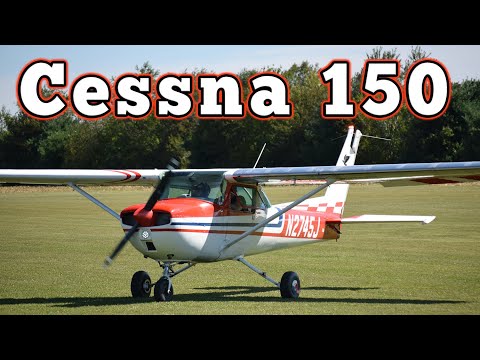
The Cessna 150 is the aeroplane a generation of pilots learned to fly in: a two-seat, high-wing, tricycle-gear trainer built from 1958 to 1977, in greater numbers than any other two-seat Cessna. It arrived as the nosewheel answer to the tailwheel Cessna 120 and 140 – easier to taxi, far harder to ground-loop, and forgiving enough to hand to a student on their first lesson – and in doing so it settled what a primary trainer was supposed to be. The Cessna 152 inherited that formula almost unchanged. Thousands of 150s remain on the register today, and the type is still one of the cheapest ways into certificated aircraft ownership.
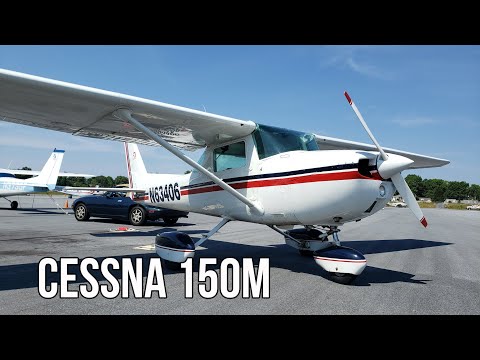
Powered by the 100 hp Continental O-200, the 150 is simple, slow, and reliable. It is not a cross-country machine; it is an airplane for learning to fly, for local flying, and for owners who want a very low cost of certificated ownership. Later variants include the aerobatic A150 Aerobat and the 150M with its squared “Commuter” wingtips and revised cabin. Earlier airplanes wore straight tails; the swept tail arrived with the 150F and became the defining look of the type.
Key Features for GA Buyers
- Low cost of ownership. Fuel burn is about 5.6 gallons per hour on the Continental O-200, annual inspections are straightforward on a simple fixed-gear airframe with no complex systems, and our cost model puts direct operating cost near $78 per hour.
- Forgiving handling. The high wing, wide CG envelope, and a gentle clean stall near 48 knots were deliberate trainer design choices. Stalls are well-mannered and recoverable and the airplane is stable in normal flight, which makes it accessible for low-time pilots.
- Strong parts and type support. The 150 was built in large numbers and many remain in service, so parts are widely available, mechanics know the type well, and owner communities are active.
- Aerobat variant. The A150 Aerobat is approved for spins, loops, and basic aerobatics, a certificated aerobatic option at low cost.
Trade-offs
- Narrow cabin. The 150’s cabin is tight; pilots much above 6 feet or 200 pounds will find it close on anything longer than a local flight, and two larger adults sit shoulder to shoulder.
- Low useful load. MTOW is 1,600 lb and useful load is about 478 lb. With full usable fuel (about 22.5 gallons, 135 lb), payload drops to roughly 343 lb, barely two average adults with no baggage, so weight and balance planning matters every flight.
- Performance at density altitude. A sea-level climb around 670 fpm is adequate until a hot, high-elevation afternoon, where the 150’s modest power shows; density altitude deserves respect.
- Age. These are old airframes, the most recent now approaching fifty years, so corrosion, control-surface fabric, and the accumulated history of a high-cycle trainer all deserve scrutiny at pre-buy.
See Also
- Cessna 152 – the direct successor; Lycoming O-235-L2C with longer TBO, same airframe, slightly more power Compare
- Piper PA-38 Tomahawk – the primary contemporary competitor; low-wing design, more responsive handling, similar mission Compare
- Beechcraft Skipper 77 – another late-1970s two-seat trainer; less common but shares the budget-trainer niche Compare
- Luscombe 8 – a vintage alternative; tailwheel, all-metal construction, appealing to pilots seeking a classic aircraft Compare
- Grumman American AA-1 – a more responsive two-seater; faster and more slippery than the 150, with a different handling character Compare
Featured in our buying guides
Technical Specifications
Dimensions & Weights
- Height
- 8 ft
- Length
- 24 ft
- Parking area (ft²2)
- 1,248 ft²
- Max Takeoff Weight
- 1,600 lbs
- Max Landing Weight
- 1,600 lbs
- Useful Load
- 478 lbs
- Fuel Capacity
- Source: FAA Type Certificate Data Sheet 23 gal
Performance
- Cruise Speed
- 107 KTAS
- Never-Exceed (VNE)
- Source: FAA Type Certificate Data Sheet 141 KIAS
- Max Structural Cruise (VNO)
- Source: FAA Type Certificate Data Sheet 107 KIAS
- Approach Speed
- 60 KIAS
- Stall, Clean (VS1)
- 48 KIAS
- Range
- 420 NM
- Service Ceiling
- 14,000 ft
- Rate of Climb
- 670 fpm
- Takeoff over 50 ft obstacle
- 1,385 ft
- Landing over 50 ft obstacle
- 1,075 ft
Engine
Log in to view or request powerplant data.
Sources
Where the figures on this page come from. Cessna 150 specifications are traced to published references; estimated values are flagged inline next to the figure.
-
FAA TCDS 3A19 (Rev 50), Cessna 150 serials 15077006 through 15079405, Airspeed Limits (IAS) dyzz9obi78pm5.cloudfront.net
-
Cessna 150 Owner's Manual, Section 5 Operational Data, LANDING DISTANCE chart www.grahamswebdesign.com
-
Pilot's Operating Handbook, Cessna 1977 Model 150M, Figure 5-10 LANDING DISTANCE / SHORT FIELD (cross-check) www.cpaviation.com
Similar to the Cessna 150
Similar PistonsAero Commander 200
Aviat A-1 Husky
Beechcraft Bonanza 33
Compare the Cessna 150 to other aircraft