Bombardier Learjet 60
Turbofan • twin engine • Low Wing • Retractable gear
Range Visualization
Origin: · click map to move · nm at current load
Payload vs. Range
Customize assumptions
Default: 190 lbs (FAA standard)
Default: 30 lbs
Mission Profile
- High-Altitude
- Pressurization
- Multi-Engine
- Instrument
About the Bombardier Learjet 60
Overview
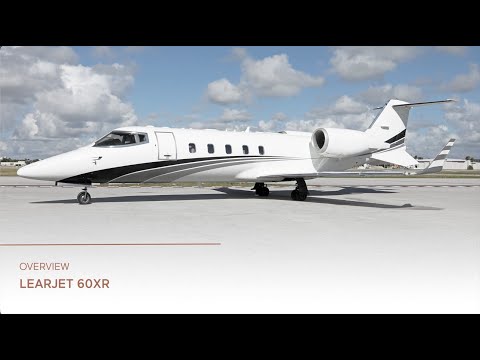
The Bombardier Learjet 60, with the later 60XR designation covering the production run from 2007 onward, is a mid-size business jet inheriting the stand-up cabin of the Learjet 55 but moving to twin Pratt & Whitney Canada PW305A turbofans, FADEC engine control, and a full Rockwell Collins Pro Line glass-cockpit suite. First flown in 1990 and certificated in 1993, the Model 60 corrected the 55’s primary criticisms (the older TFE731 engines, mechanical thrust management, and analog instrumentation), while keeping the cabin volume and 51,000-foot ceiling that made the 55 the first stand-up Learjet. 318 standard 60s were built through 2007; the 60XR variant ran from 2007 to 2013 with cabin and avionics upgrades.
For the GA buyer, the Learjet 60 sits squarely in the mid-size cabin bracket alongside the Cessna Citation V/Ultra/Encore, Cessna Excel/XLS, and Hawker 800XP. It out-climbs and out-ceilings most direct competitors, with a typical climb to FL410 in 18 minutes and a 51,000-foot certified ceiling, and offers approximately 2,400 nm in optimum conditions. The trade-off is runway: the Lear 60 wants 5,000-plus feet at sea-level MTOW, more than the Excel and the Encore. PW305A engines, when enrolled in Pratt & Whitney’s ESP program, run on-condition; otherwise published TBO is 5,000 hours.
Key Features for GA Buyers
- High-altitude performance. Certified to 51,000 ft with a typical climb to FL410 in 18 minutes, well above most weather, traffic, and competing midsize jets.
- PW305A turbofans. 4,600 lbf each, FADEC-controlled, hot-and-high-friendly. ESP enrollment converts maintenance to on-condition.
- Stand-up cabin. Roughly 5‘7” cabin height carried over from the Learjet 55, with a full club-four-plus-aft-galley layout.
- Glass cockpit on the 60XR. Rockwell Collins Pro Line 21 in 60XR; Pro Line 4 in earlier 60s. Both are well-supported, single-pilot-capable suites.
Trade-offs
- Runway demand. Balanced field length around 5,360 ft at sea level limits access to shorter runways relative to the Cessna Excel/XLS and similar lighter-midsize jets.
- Operating cost. Approximately $3,200/hr DOC at 300 hours/year typical utilization, with around 235 GPH cruise fuel burn. Heavier per hour than the mid-light bracket but typical for the class.
- Older airframes. Standard 60s built 1993 to 2007 may show more corrosion and fatigue exposure than the 60XR run; pre-buy diligence on landing-gear and brake-line wear is the typical inspector emphasis.
See Also
- Bombardier Learjet 55 – direct predecessor, same stand-up cabin, TFE731-3A engines and 1980s avionics. Compare
- Bombardier Learjet 35/36 – the smaller-cabin Lear with TFE731 engines and a different mission shape. Compare
- Cessna Citation V/Ultra/Encore – the closest mid-light cabin competitor, lighter on fuel and runway. Compare
- Cessna Excel/XLS – the direct mid-size competitor with stand-up cabin and shorter-runway capability. Compare
- Hawker 800XP – the bracket-up competitor offering a larger cabin and longer range, at higher operating cost. Compare
Technical Specifications
Dimensions
- Wingspan
- 43.75 ft
- Length
- 58.67 ft
- Height
- 14.58 ft
- Parking area (ft2)
- 3422.26 ft2
Weights
- Max Takeoff Weight
- 23,500 lbs
- Max Landing Weight
- 19,500 lbs
- Useful Load
- 8,848 lbs
- Fuel Capacity
- 1185 gal
Performance
- Cruise Speed
- 436 KTAS
- Never-Exceed (Vne)
- 492 KIAS
- Approach Speed
- 125 KIAS
- Stall, Clean (Vs1)
- 96 KIAS
- Range
- 2398 NM
- Service Ceiling
- 51,000 ft
- Rate of Climb
- 4500 fpm
- Takeoff over 50 ft obstacle
- 5,450 ft
- Landing ground roll
- 3,009 ft
Similar to the Bombardier Learjet 60

Learjet 75
Bombardier Learjet 45
Cessna Citation II/Bravo
Cessna Excel/XLS
Learjet 24
Bombardier Learjet 35/36
Gulfstream G150
Cessna Citation CJ3
See how the Bombardier Learjet 60 stacks up against similar aircraft
External Media



Other Links
-
Learjet 60 - Wikipedia en.wikipedia.org
-
Turbine Pilot: Quick Look (Learjet 60/60XR) - AOPA www.aopa.org
-
Learjet 60 - Business Jet Traveler www.bjtonline.com
-
LEARJET 60 Specifications, Operating Cost, Performance - Globalair.com www.globalair.com
-
Bombardier Learjet 60XR brochure, performance, market - Guardian Jet www.guardianjet.com