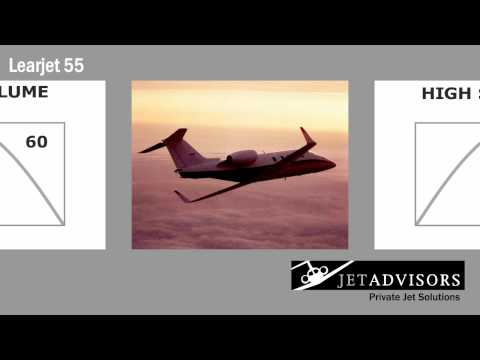
Bombardier Learjet 55
Turbofan • twin engine • Low Wing • Retractable gear
Range Visualization
Origin: · click map to move · nm at current load
Payload vs. Range
Customize assumptions
Default: 190 lbs (FAA standard)
Default: 30 lbs
Mission Profile
- High-Altitude
- Pressurization
- Multi-Engine
- Instrument
About the Bombardier Learjet 55
Overview
The Bombardier Learjet 55, branded the “Longhorn” for its distinctive winglets, is the first stand-up-cabin Learjet and a deliberate Gates Learjet attempt to compete with the larger Cessna Citation III and Hawker 800 brackets. First flown in 1979 and certificated in 1981, the Model 55 paired a new larger fuselage with the supercritical “Longhorn” wing originally developed for the abandoned Learjet 28/29 program. 147 airframes were built across the 55, 55B, and 55C variants through 1986; the line was succeeded several years later by the redesigned Learjet 60, which shared the cabin but moved to PW305A turbofans. All 55-series variants used twin Honeywell TFE731-3A turbofans rated at 3,700 lbf each.
For the GA buyer, the Learjet 55 sits in a transition bracket: it carries the Lear performance pedigree but adds the cabin volume that the rest of the family lacks. Compared with the Learjet 35/36 it gives up some cruise speed and trades up for stand-up cabin height, longer transcontinental range, and the supercritical wing’s improved low-speed manners. Compared with the Cessna Citation V, it offers a higher ceiling and a more spirited handling character but lower fuel economy and a longer required runway. The natural step-up is the Learjet 60, which inherits the cabin and adds modern avionics, FADEC, and meaningfully better range.
Key Features for GA Buyers
- Stand-up cabin. Unlike previous Learjets, the Model 55 features a cabin height of roughly 5‘7”, allowing for much greater passenger comfort during longer flights.
- High-altitude performance. Certified for flights up to 51,000 ft, allowing it to climb above most weather and commercial traffic for smoother, more direct routing.
- Range. Capable of transcontinental flights (approximately 2,000+ nm), making it a versatile option for business travel.
Trade-offs
- Runway performance. Requires a relatively long runway for takeoff (5,600+ ft at sea level), which may limit access to smaller general aviation airports compared to lighter jets or turboprops.
- Operating costs. As an older jet with twin turbofan engines, fuel burn and maintenance costs are higher than modern light jets.
See Also
- Bombardier Learjet 35/36 – the smaller-cabin predecessor sharing the TFE731 powerplant family. Compare
- Bombardier Learjet 31 – the light-jet descendant that uses the 55’s “Longhorn” wing without tip tanks. Compare
- Bombardier Learjet 60 – the direct successor with PW305A turbofans, modern avionics, and longer range. Compare
- Cessna Citation V/Ultra/Encore – the closest direct competitor in the mid-light cabin bracket. Compare
- Hawker 800XP – the bracket-up competitor offering a larger cabin and more range. Compare
Technical Specifications
Dimensions
- Wingspan
- 43.8 ft
- Length
- 55.1 ft
- Height
- 14.7 ft
- Parking area (ft2)
- 3233.38 ft2
Weights
- Max Takeoff Weight
- 21,500 lbs
- Max Landing Weight
- 18,000 lbs
- Useful Load
- 8,857 lbs
- Fuel Capacity
- 1000 gal
Performance
- Cruise Speed
- 420 KTAS
- Max Structural Cruise (Vno)
- 461 KIAS
- Approach Speed
- 143 KIAS
- Stall, Clean (Vs1)
- 110 KIAS
- Range
- 2165 NM
- Service Ceiling
- 51,000 ft
- Rate of Climb
- 1240 - 4180 fpm
- Takeoff over 50 ft obstacle
- 5,600 ft
- Landing ground roll
- 2,800 ft
Similar to the Bombardier Learjet 55

Cessna Citation CJ4
Cessna Citation CJ3
Bombardier Learjet 25
See how the Bombardier Learjet 55 stacks up against similar aircraft