Range Map
Origin: → · two fingers to move map
Payload vs. Range
Fuel on board
Cargo
nm
Range
Trip Preview
Name a destination in the map header above and this becomes your trip: time en route, what you burn, what it costs, and whether you get there without stopping — at the load you have set.
→
Over max payload by . At this load it cannot lift a single occupant. Please adjust your payload inputs.
We do not have a cruise speed on file for this aircraft, so there is no honest time or cost to give you for this leg.
En route
Fuel burned
Direct cost
Fuel cost
Tanks run dry about past before at this burn.
Mission Profile
- Complex
- Multi-Engine
.jpg)
Estimated Ownership Costs
Create a free account to view or request ownership cost data.
About the Diamond Twin Star
Type certificated 2009
Overview
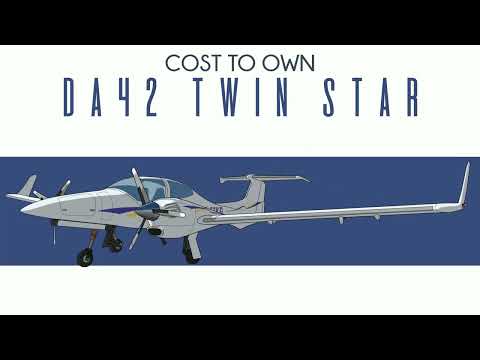
The Diamond DA42-VI is the current production version of Diamond Aircraft’s four-seat composite light twin, the definitive modern diesel twin and a popular choice for multi-engine training. It is powered by two 168-horsepower Austro AE300 turbocharged common-rail diesels that burn Jet-A through single-lever FADEC control, with auto-feathering and a positive single-engine climb at high density altitude. The DA42 line began with Thielert gasoline-diesel engines in 2004; the Austro-powered DA42 NG was certified under EASA type certificate EASA.A.005 (JAR-23) in 2009, and the aerodynamically refined DA42-VI followed in 2012 and remains in production.
Choose the DA42-VI when the mission is genuine twin-engine redundancy at the lowest possible operating cost. Total fuel burn of roughly 10 to 13 gph of Jet-A is comparable to a single high-performance piston, and worldwide Jet-A availability frees it from the shrinking avgas supply. It sits in the middle of Diamond’s diesel line, a step up from the single Diamond DA40 NG and below the larger seven-seat Diamond DA62; its natural cross-shops are the legacy avgas twins it undercuts on fuel and simplicity, the Beechcraft Baron 58 and the Piper Seneca. Flight schools favor it for multi-engine training, and owners choose it for the safety margin of a second engine without legacy-twin fuel and maintenance bills.
Key Features for GA Buyers
- Single-engine fuel burn on two engines. Roughly 10 to 13 gph of Jet-A total at cruise, a fraction of what a Baron or Seneca drinks, with the security of a second engine.
- Single-lever FADEC. Full-authority digital engine control manages power, propeller, and mixture on each engine, with automatic feathering, cutting the multi-engine workload and the engine-failure error surface dramatically.
- Modern composite safety cell. A crashworthy carbon-fiber fuselage, energy-absorbing structure, and a lightning-protection system back one of the best safety records among light twins.
- Real single-engine climb. Unlike many legacy light twins, the DA42-VI holds a positive rate of climb on one engine at high density altitude, which is the whole point of carrying two.
Trade-offs
- Diesel maintenance is its own discipline. The Austro AE300 carries a gearbox, coolant system, and FADEC that a Lycoming twin does not, and overhaul reserves plus calendar-limited items add a maintenance line the fuel savings must outrun.
- Snug cabin. The cockpit is tight for two broad-shouldered adults side-by-side, and four adults with full long-range fuel (76 gal) requires careful weight planning.
- Acquisition cost and lead time. Strong training demand keeps used prices high and new-delivery waits long; it is materially more expensive to buy than a comparable avgas twin.
- Multi-engine and complex requirements. As a retractable-gear twin it requires multi-engine and complex endorsements, and insurance reflects the twin-engine training mission.
See Also
- Diamond DA40 NG – the single-engine diesel sibling on the same Jet-A FADEC platform; the typical step-down or owner-progression precedent. Compare
- Diamond DA62 – the larger seven-seat twin-diesel step-up, more cabin and payload on the same fuel philosophy. Compare
- Beechcraft Baron 58 – the benchmark legacy avgas piston twin; faster and roomier but far thirstier and more complex to operate. Compare
- Piper Seneca – the other legacy training twin; a turbocharged avgas alternative cross-shopped on price and mission. Compare
Technical Specifications
Dimensions & Weights
- Height
- 8 ft
- Length
- 28 ft
- Parking area (ft²2)
- 1,797 ft²
- Max Takeoff Weight
- 4,407 lbs
- Max Landing Weight
- 4,189 lbs
- Useful Load
- 1,299 lbs
- Fuel Capacity
- Source: FAA Type Certificate Data Sheet 76 gal
Performance
- Cruise Speed
- Source: manufacturer figure 175 KTAS
- Never-Exceed (VNE)
- Source: FAA Type Certificate Data Sheet 192 KIAS
- Max Structural Cruise (VNO)
- Source: FAA Type Certificate Data Sheet 155 KIAS
- Approach Speed
- 85 KIAS
- Stall, Clean (VS1)
- Estimated/derived; not a published figure 67 KIAS
- Range
- 1215 NM
- Service Ceiling
- 18,000 ft
- Rate of Climb
- 170 - 1550 fpm
- Takeoff over 50 ft obstacle
- 1,961 ft
- Landing over 50 ft obstacle
- 1,870 ft
Engines
Log in to view or request powerplant data.
Sources
Where the figures on this page come from. Diamond Twin Star specifications are traced to published references; estimated values are flagged inline next to the figure.
Similar to the Diamond Twin Star
Similar PistonsGulfstream American GA7
Tecnam P2006T
Piper Seminole
Beechcraft Duchess 76
Compare the Diamond Twin Star to other aircraft