Range Map
• nm at current load
• click map to move • two fingers to move map
Payload vs. Range
Fuel on board
Extra weight
nm
Range
Mission Profile
- High-Performance
- Complex
- High-Altitude
- Pressurization
- Instrument
_(4-9-2024).jpg)
Estimated Ownership Costs
Create a free account to view or request ownership cost data.
About the Daher TBM 980
Type certificated 2025 Source: FAA Type Certificate Data Sheet
Overview
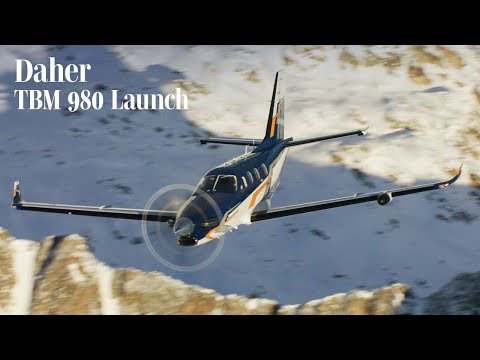
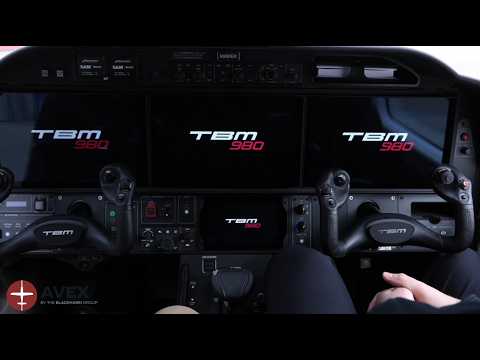
The Daher TBM 980 is the current flagship of the TBM single-engine turboprop family, unveiled in January 2026 as the sixth model in the TBM 900 series. It carries over the proven aerodynamic airframe and the Pratt & Whitney Canada PT6E-66XT engine with single-lever EPECS digital control, so its performance is unchanged from the 960: 330 KTAS at FL280, 1,730 nm of range, and a 31,000 ft ceiling. What sets the 980 apart sits in the cockpit and cabin. It is the first production TBM to fly behind the Garmin G3000 Prime integrated flight deck, a third-generation system built around three 14-inch edge-to-edge multi-touch displays with substantially more processing headroom and an app-style interface that shortcuts the most-used functions.
Beyond avionics, the 980 adds a Starlink Mini terminal for satellite cabin connectivity, 100-watt USB-C charging at each seat, and an upgraded passenger display, alongside the e-copilot safety suite with emergency descent mode and HomeSafe emergency autoland. It earned EASA type certification in December 2025, with FAA validation and first deliveries following in January 2026, at a $5.82 million list price, positioned just above the still-current 960. Choose the TBM 980 when the latest flight deck and connected cabin matter most; the 960 and used 900-series airframes deliver nearly identical speed and range on earlier avionics for less.
Key Features for GA Buyers
- Garmin G3000 Prime flight deck. The first production TBM with Garmin’s third-generation deck: three 14-inch multi-touch displays, more processing headroom, and an app-style interface that reduces single-pilot workload.
- Single-lever digital turbine. The PT6E-66XT’s EPECS reduces engine and propeller management to one e-throttle with full FADEC-like exceedance protection, carried over from the 960.
- HomeSafe emergency autoland. Garmin’s autoland can land the aircraft at a suitable airport if the pilot is incapacitated, part of the e-copilot safety suite.
- Connected cabin. A Starlink Mini terminal, per-seat 100-watt USB-C charging, and an upgraded passenger display bring the cabin experience up to current expectations.
Trade-offs
- Newest-flight-deck premium. At a $5.82 million list price the 980 sits above the 960, which flies the same speed and range on the prior G3000 deck; the premium buys avionics and cabin technology, not performance.
- Single-engine in the flight levels. Like every TBM, the 980 flies a high-altitude single-engine mission; buyers cross-shopping the PC-12 or a light twin accept one engine for the speed and economics.
- Transition cost for the owner-pilot. Moving into a turbine at this hull value brings a steep insurance and recurrent-training requirement, typically the largest early fixed cost.
- Early-production unknowns. As a 2026 introduction, the in-service maintenance history and resale behavior of the 980 and its G3000 Prime deck are not yet established.
See Also
- Daher TBM 960 – the immediate predecessor; same airframe and PT6E engine, prior G3000 deck. Compare
- Daher TBM 940 – the earlier autothrottle model on the manual-lever PT6A. Compare
- Daher TBM 900 – the airframe origin of the series. Compare
- Pilatus PC-12 – the single-turboprop competitor with a larger cabin and slower cruise. Compare
- Epic E1000 – composite single turboprop matching the TBM on speed. Compare
Technical Specifications
Dimensions & Weights
- Height
- 14 ft
- Length
- 35 ft
- Parking area (ft²2)
- 2,094 ft²
- Max Takeoff Weight
- Source: FAA Type Certificate Data Sheet 7,615 lbs
- Max Landing Weight
- 7,110 lbs
- Useful Load
- 2,833 lbs
- Fuel Capacity
- 292 gal
Performance
- Cruise Speed
- Source: manufacturer figure 330 KTAS
- Never-Exceed (VNE)
- Source: manufacturer figure 266 KIAS
- Max Structural Cruise (VNO)
- Source: manufacturer figure 266 KIAS
- Approach Speed
- 85 KIAS
- Stall, Clean (VS1)
- Source: third-party reference 81 KIAS
- Range
- Source: manufacturer figure 1730 NM
- Service Ceiling
- 31,000 ft
- Rate of Climb
- 2000 fpm
- Takeoff over 50 ft obstacle
- 2,535 ft
- Landing ground roll
- 2,430 ft
Engine
Log in to view or request powerplant data.
Sources
Where the figures on this page come from. Daher TBM 980 specifications are traced to published references; estimated values are flagged inline next to the figure.
-
Daher TBM 900-series Pilot's Information Manual, airspeed limitations. Single-VMO airframe (the airspeed-indicator green arc tops at VMO; there is no separate VNO). The 980 shares the TBM700N airframe and the same VMO. Stored as the indicated value per the catalogue IAS convention; EASA TCDS A.010 §B.III.10 gives the same limit as 271 KCAS. www.tbm.aero
-
-
EASA TCDS A.010 Issue 22 §B.I.5 — TBM980 EASA Type Certificate Date www.easa.europa.eu
-
AOPA Aircraft Guide: Daher TBM 960 — stall speeds (type-common across the TBM700N line; the 980 shares the airframe). Vs1 is the clean/flaps-up stall; the landing-configuration Vs0 is the lower 65 KIAS. www.aopa.org
Similar to the Daher TBM 980
Similar TurbopropsDaher TBM 850
Epic E1000
Piper M700
Epic LT
Piper M600
Piper M500
Compare the Daher TBM 980 to other aircraft