Range Map
• nm at current load
• click map to move • two fingers to move map
Payload vs. Range
Configure weights
Default: 190 lbs
Default: 30 lbs
gal
Fuel on board
lbs
Extra weight
nm
Range
Mission Profile
- High-Altitude
- Pressurization
- Multi-Engine
- Instrument
Estimated Ownership Costs
About the Bombardier Challenger 3500
Type certificated 2022 Source: manufacturer figure
Overview
The Bombardier Challenger 3500 is a super-midsize business jet, introduced in 2022 as the latest configuration of the BD-100-1A10 platform that began with the Challenger 300 in 2003 and the Challenger 350 in 2014. It pairs the proven Challenger 350 airframe and Honeywell HTF7350 engines with a redesigned cabin: Nuage zero-gravity seating, a voice-controlled cabin-management system, and a 4,850 ft cabin altitude at FL410, plus standard autothrottles on the flight deck. Performance carries over unchanged from the 350: 3,400 nm of range, a 45,000 ft ceiling, Mach 0.83 top speed, and the same 40,600 lb maximum takeoff weight, steep-approach approval for London City, and the high-elevation performance to serve fields like Aspen.
For the buyer, the 3500 is less a new airplane than a question about cabin and avionics. It flies the 350’s mission exactly, so the real decision is whether the wellness cabin and standard autothrottles justify a new-delivery premium over a used 350 that performs identically. They do for an owner who prizes the passenger experience and wants factory-fresh systems on an airframe they intend to hold; they matter less to a buyer who charters or flies the airplane for its legs rather than its lighting. Against the Embraer Praetor 600, the Challenger gives up range and fly-by-wire for a wider cabin and Bombardier’s larger fleet and support base in the segment; a buyer who instead prioritizes short-field performance should weigh the Gulfstream G280, which trades cabin width for runway access and slightly longer legs. The limit to keep in view is the one the whole family shares: full-fuel payload is tight, so the 3,400 nm range and a full cabin rarely belong to the same leg.
Key Features for GA Buyers
- Nuage seating in the super-midsize class. The 3500 brought Bombardier’s Nuage zero-gravity seat, with its tilt-and-recline mechanism, to the super-midsize cabin. It is the upgrade that most distinguishes it from a used 350.
- A wide, low-altitude cabin. The BD-100 cross-section is among the widest in the segment, and the 3500 holds a 4,850 ft cabin altitude at FL410.
- Autothrottles standard. Standard-fit autothrottle trims crew workload, and the airframe’s steep-approach certification reaches restrictive fields such as London City.
Trade-offs
- An evolution, not a clean sheet. The 3500 shares the 350’s airframe, engines, and performance; the gains are cabin and avionics, so a used 350 covers the same mission for less when the refresh is not the point.
- Tight full-fuel payload. Like the rest of the family, filling the tanks leaves limited cabin payload, so the headline 3,400 nm range and a full cabin are not available on the same flight.
See Also
- Bombardier Challenger 350 – the airframe and engines this jet refreshes; identical performance, an older cabin. Compare
- Embraer Praetor 600 – the super-midsize cross-shop from Embraer; fly-by-wire and more range for a narrower cabin. Compare
- Gulfstream G280 – the short-field specialist; more runway efficiency and slightly longer legs for a smaller cabin. Compare
- Cessna Citation Longitude – Textron’s super-midsize entry; a newer clean-sheet design with a stand-up cabin and similar range. Compare
Base model
Bombardier Challenger 300Technical Specifications
Dimensions & Weights
- Height
- 20.25 ft
- Length
- 68.7 ft
- Parking area (ft2)
- 5822.3 ft2
- Max Takeoff Weight
- Source: manufacturer figure 40,600 lbs
- Max Landing Weight
- Source: manufacturer figure 34,150 lbs
- Useful Load
- Source: third-party reference 15,800 lbs
- Fuel Capacity
- Source: FAA Type Certificate Data Sheet 2096 gal
Performance
- Cruise Speed
- Source: manufacturer figure 459 KTAS
- Never-Exceed (VNE)
- Source: FAA Type Certificate Data Sheet 320 KIAS
- Max Structural Cruise (VNO)
- Source: FAA Type Certificate Data Sheet 300 KIAS
- Range
- Source: manufacturer figure 3400 NM
- Service Ceiling
- Source: manufacturer figure 45,000 ft
- Takeoff over 50 ft obstacle
- 4,835 ft
- Landing ground roll
- 2,364 ft
Sources
Where the figures on this page come from. Bombardier Challenger 3500 specifications are traced to published references; estimated values are flagged inline next to the figure.
Similar to the Bombardier Challenger 3500
Similar TurbofansBombardier Challenger 350
Cessna Citation Longitude
Cessna Citation Sovereign
See how the Bombardier Challenger 3500 stacks up against similar aircraft
External Media
Videos
-
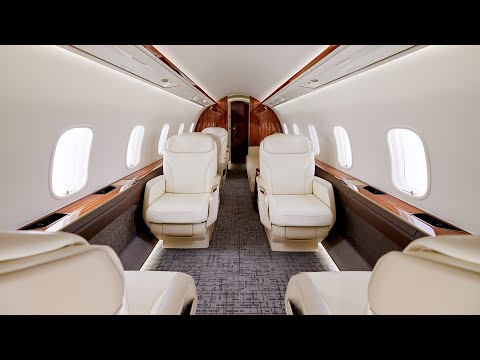
Inside the Challenger 3500: Nuage Seats & Cabin Tech Walkthrough
-
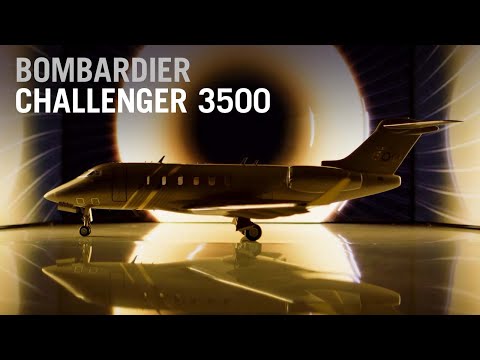
Official Feature: Challenger 3500 Performance That Delivers
-
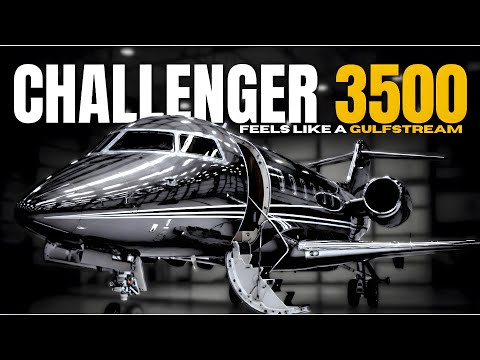
Market Comparison: The Super-Midsize Jet That Feels Like a Global
-

Technical Review: Detailed Look Inside and Out
-
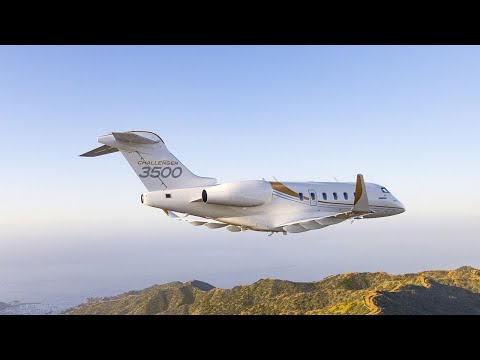
Operator Overview: Challenger 3500 Cabin Features & Connectivity
Image Galleries
-
Bombardier Challenger 3500 (SP-IRT, c/n 20975) on approach to Berlin Brandenburg, June 2024. Photo: André Gerwing, CC BY-SA 4.0. commons.wikimedia.org
-
-
_2024-06-10_Andre_Gerwing_Collection_ID_019629.jpg?utm_source=choosemyplane.com&utm_content=textlink)
_(3-18-2023).jpg?utm_source=choosemyplane.com&utm_content=textlink)

Articles and other links
-
Official Bombardier Challenger 3500 Product Overview bombardier.com
-
Wikipedia: Bombardier Challenger 3500 Development & Specifications en.wikipedia.org
-
Business Jet Traveler: An Inside Look at the New 3500 www.bjtonline.com
-
Aviation Week: Challenger 300/350/3500 Fleet and Mission Data aviationweek.com
-
AIN Online: First Challenger 3500 Charter Deliveries www.ainonline.com
-
-