Range Map
Origin: → · two fingers to move map
Payload vs. Range
Fuel on board
Cargo
nm
Range
Trip Preview
Name a destination in the map header above and this becomes your trip: time en route, what you burn, what it costs, and whether you get there without stopping — at the load you have set.
→
Over max payload by . At this load it cannot lift a single occupant. Please adjust your payload inputs.
We do not have a cruise speed on file for this aircraft, so there is no honest time or cost to give you for this leg.
En route
Fuel burned
Direct cost
Fuel cost
Tanks run dry about past before at this burn.
Mission Profile
- High-Performance
- Complex
- High-Altitude
- Pressurization
- Multi-Engine
- Instrument

Estimated Ownership Costs
Create a free account to view or request ownership cost data.
About the Piaggio P-180 Avanti
Type certificated 1990 Source: FAA Type Certificate Data Sheet
Overview
The Piaggio P.180 Avanti II is a twin-turboprop business aircraft that delivers jet-class cruise speed at turboprop fuel burn. Its three-surface design, a forward canard, a mid-set main wing behind the cabin, and a conventional horizontal tail, moves the wing structure aft of the pressure vessel, leaving a wide, stand-up cabin uninterrupted by a spar. Two rear-mounted Pratt & Whitney Canada PT6A-66B pusher turboprops, flat-rated at 850 shp each, drive a maximum cruise of 402 knots true at up to 41,000 feet.
The type traces to the original P.180 Avanti, certified in Italy in 1990; the Avanti II added the uprated -66B engines and updated avionics in 2005. It occupies an unusual niche, faster than any cabin-class turboprop twin and competitive with entry-level jets on speed while burning far less fuel. Cross-shoppers weigh it against the Cessna Conquest II for a conventional pressurised twin and the Pilatus PC-12 for cabin and range in a single; the Piaggio Avanti EVO is the current-production evolution.
Key Features for GA Buyers
- Jet speed on turboprop fuel. A maximum cruise near 402 knots true rivals entry-level jets while normal-cruise fuel burn stays around 90 gallons per hour, so trip times approach jet numbers at turboprop direct cost.
- Cabin larger than the class. Roughly six feet of stand-up height and a width beyond most light jets seat seven to nine passengers, with the pusher propellers mounted behind the pressure vessel for low cabin noise.
- High-altitude capability. A 41,000-foot service ceiling lets the Avanti cruise above most weather and traffic, unusual for a turboprop.
- Twin-PT6A reliability. Two Pratt & Whitney Canada PT6A-66B engines, flat-rated at 850 shp, pair the redundancy of a twin with one of the most proven turboprop engine families in service.
Trade-offs
- Demanding to own and fly. A complex, high-performance, pressurised twin requires type-specific training and the high-performance, complex, high-altitude, pressurisation, and multi-engine endorsements.
- Real operating cost. Direct operating cost runs around 1,100 dollars per hour before fixed costs, and overhaul reserves on two PT6A-66B engines are a meaningful budget line.
- Thinner support network. The unconventional configuration and low production numbers mean fewer shops and a narrower parts pipeline than mainstream turboprops; Piaggio Aerospace spent years in administration before its 2025 acquisition by Baykar.
- Niche resale. A small fleet and specialized maintenance make values more variable than mainstream cabin-class types, so confirm regional service access before buying.
See Also
- Piaggio Avanti EVO – the current-production evolution with winglets and five-blade scimitar propellers Compare
- Cessna Conquest II – a conventional pressurised turboprop twin in a similar cabin-class mission Compare
- Cessna Conquest I – a lighter pressurised turboprop twin alternative Compare
- Pilatus PC-12 – a premium turboprop cross-shopped for cabin size and range Compare
Technical Specifications
Dimensions & Weights
- Height
- 13 ft
- Length
- 47 ft
- Parking area (ft²2)
- 2,929 ft²
- Max Takeoff Weight
- 12,100 lbs
- Max Landing Weight
- 11,500 lbs
- Useful Load
- 4,150 lbs
- Fuel Capacity
- Source: FAA Type Certificate Data Sheet 419 gal
Performance
- Cruise Speed
- 402 KTAS
- Never-Exceed (VNE)
- Source: FAA Type Certificate Data Sheet 260 KIAS
- Max Structural Cruise (VNO)
- Source: FAA Type Certificate Data Sheet 260 KIAS
- Approach Speed
- 121 KIAS
- Stall, Clean (VS1)
- 93 KIAS
- Range
- 1470 NM
- Service Ceiling
- 41,000 ft
- Rate of Climb
- 2770 fpm
Engines
Log in to view or request powerplant data.
Sources
Where the figures on this page come from. Piaggio P-180 Avanti specifications are traced to published references; estimated values are flagged inline next to the figure.
Similar to the Piaggio P-180 Avanti
Similar TurbopropsPiaggio Avanti EVO
Piper Cheyenne 400
Piper PA-42 Cheyenne III
Mitsubishi MU-2B-60 Marquise
Fairchild Swearingen Merlin IIIB
Cessna 441 Conquest II
Beechcraft King Air 250
Beechcraft King Air F90
Compare the Piaggio P-180 Avanti to other aircraft
External Media
Videos
-
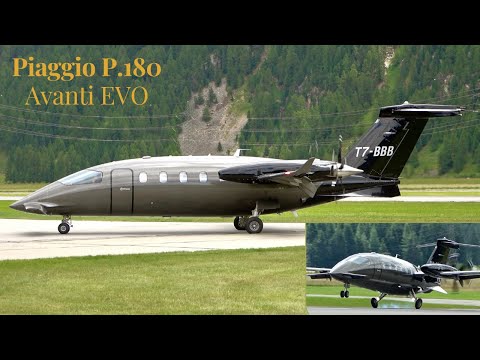
Piaggio P-180 Avanti EVO Landing & Take-Off at Engadin Airport - YouTube
-
Piaggio Aerospace - P180 Avanti II Acrobatic Display - YouTube
-
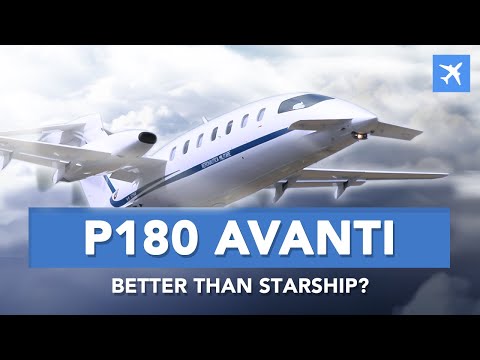
Piaggio P180 Avanti – Better Starship? History, Review and Specs! - YouTube
-

MIND BLOWING Features of the P180 Piaggio Avanti - Pilot Walkaround - YouTube
-

Piaggio P180 Avanti Flight (Inflight Cockpit Tour!) - YouTube