Range Map
Origin: → · two fingers to move map
Payload vs. Range
Fuel on board
Cargo
nm
Range
Trip Preview
Name a destination in the map header above and this becomes your trip: time en route, what you burn, what it costs, and whether you get there without stopping — at the load you have set.
→
Over max payload by . At this load it cannot lift a single occupant. Please adjust your payload inputs.
We do not have a cruise speed on file for this aircraft, so there is no honest time or cost to give you for this leg.
En route
Fuel burned
Direct cost
Fuel cost
Tanks run dry about past before at this burn.
Mission Profile

Estimated Ownership Costs
Create a free account to view or request ownership cost data.
About the Icon A-5
Overview
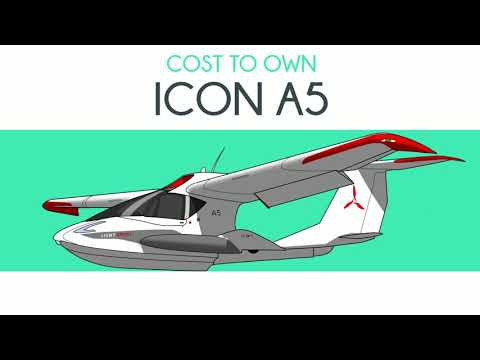
The ICON A5 is a two-seat amphibious Light-Sport Aircraft built by ICON Aircraft of Vacaville, California, and first flown in 2008. It was conceived for a buyer general aviation usually misses: the recreational pilot who wants to fly off water on a sport-pilot certificate, in an airplane styled and equipped like a consumer product. The program has since changed hands – ICON filed Chapter 11 in April 2024, and SG Investment America (the US arm of Germany’s Dürkopp Adler, owned by China’s ShangGong Group) bought its assets that June, with low-volume production continuing under the new owner.
Two things define how the A5 flies. An angle-of-attack indicator anchors the cockpit, backed by an FAA-approved spin-resistance demonstration and a standard ballistic parachute – a safety package aimed at the pilot who would not otherwise consider seaplane flying. Sport-pilot access is the other half of the pitch: under the 2025 MOSAIC rule the A5 sits inside the sport-pilot envelope on its own 45-knot stall, and its original 2013 weight exemption is now legacy context. It suits the recreational or safety-minded owner who wants a weekend-lake airplane, and it asks that buyer to accept a two-seat, day-VFR envelope and the continuity questions that come with a single-model company freshly out of bankruptcy.
Key Features for GA Buyers
- Amphibious operation in a sport-pilot airframe. Land or water, paved or grass, with the retractable sponson gear handling the transition. Few certified amphibians sit at the LSA price and pilot-qualification floor.
- Folding wings and trailerability. Wings fold at the root in a few minutes, allowing the airframe to be towed home and stored in a standard garage or transported to launch sites without ferry-flying to a seaplane base.
- Spin-resistant airframe with standard parachute. FAA-approved spin-resistance demonstration plus a standard ballistic recovery system bias the A5 toward the safety-anxious recreational buyer who would not otherwise consider seaplane flying.
- Rotax 912 iS Sport fuel flexibility. The fuel-injected 912 iS Sport accepts 91-octane unleaded auto fuel as well as 100LL avgas, which lowers fuel cost at operating sites where mogas is reachable.
- Glass cockpit with integrated AOA. Garmin G3X-class panel paired with a primary AOA indicator on the glareshield – the airframe is designed to be flown by reference to AOA, not airspeed alone.
Trade-offs
- Two-seat, day-VFR sport-aircraft envelope. S-LSA category limits the A5 to two seats, day VFR, and sport-pilot operating privileges. No IFR, no night, no third seat. Buyers needing any of those should look outside the LSA class.
- Price-to-utility ratio. New A5s list well above $300,000 as configured – comparable money to a four-seat certified single. The A5 is bought for what it does (amphibious recreational flying), not for transport-economy.
- 428 nm range, 81 KTAS cruise. The mission is local and recreational. Cross-country economics do not favour the A5 against a fixed-gear four-seater at the same hourly cost.
- Service ceiling 13,000 ft. Adequate for terrain avoidance in most US contexts, but mountain-west operators should check density-altitude performance carefully.
- Orphaned-OEM and continuity diligence. The 2024 Chapter 11 impaired pre-bankruptcy factory warranties, customer deposits, and delivery-position agreements, and the reconstituted company sits under a foreign parent whose long-term aviation commitment was not stated in the court record. Production continues, but at low single-model volume under new ownership. Confirm current parts, service, and warranty terms directly with the company; do not rely on pre-2024 factory promises.
- Specialised maintenance and parts pipeline. Rotax-trained service is geographically uneven outside seaplane hubs; the composite amphibious hull is not a job for every airframe shop.
See Also
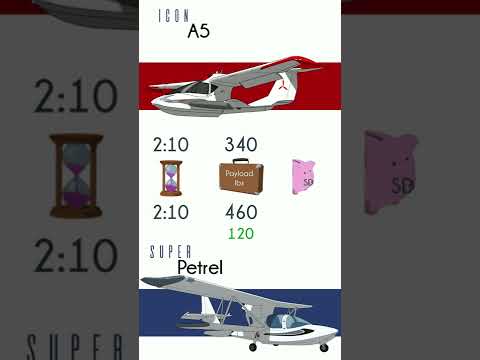
- Super Petrel LS – a direct amphibious-LSA rival: a Brazilian biplane flying boat at a fraction of the A5’s price. Compare
- Progressive Aerodyne SeaRey – the other budget amphibious-LSA rival, a widely built parasol-wing flying boat sold factory-built or as a kit. Compare
- Lake LA-4-200 Buccaneer – the certified four-seat amphibian step-up: more seats and range at higher cost and pilot qualification. Compare
- Cessna 162 Skycatcher – Cessna’s two-seat LSA, the land-based class-economics reference without the amphibious mission. Compare
Technical Specifications
Dimensions & Weights
- Height
- 8 ft
- Length
- 23 ft
- Parking area (ft²2)
- 1,254 ft²
- Max Takeoff Weight
- Source: manufacturer figure 1,570 lbs
- Max Landing Weight
- 1,570 lbs
- Useful Load
- 490 lbs
- Fuel Capacity
- Source: manufacturer figure 20 gal
Performance
- Cruise Speed
- Source: Pilot's Operating Handbook / Aircraft Flight Manual 81 KTAS
- Never-Exceed (VNE)
- Source: Pilot's Operating Handbook / Aircraft Flight Manual 120 KIAS
- Max Structural Cruise (VNO)
- Source: Pilot's Operating Handbook / Aircraft Flight Manual 95 KIAS
- Approach Speed
- 59 KIAS
- Stall, Clean (VS1)
- Source: Pilot's Operating Handbook / Aircraft Flight Manual 45 KIAS
- Range
- Source: Pilot's Operating Handbook / Aircraft Flight Manual 428 NM
- Service Ceiling
- Source: Pilot's Operating Handbook / Aircraft Flight Manual 13,000 ft
- Rate of Climb
- 610 fpm
- Takeoff over 50 ft obstacle
- 1,170 ft
- Landing over 50 ft obstacle
- 990 ft
Engine
Log in to view or request powerplant data.
Sources
Where the figures on this page come from. Icon A-5 specifications are traced to published references; estimated values are flagged inline next to the figure.
Similar to the Icon A-5
Similar PistonsAero Commander 200
Aviat A-1 Husky
Beechcraft Bonanza 33
Compare the Icon A-5 to other aircraft