Range Map
Origin: → · two fingers to move map
Payload vs. Range
Fuel on board
Cargo
nm
Range
Trip Preview
Name a destination in the map header above and this becomes your trip: time en route, what you burn, what it costs, and whether you get there without stopping — at the load you have set.
→
Over max payload by . At this load it cannot lift a single occupant. Please adjust your payload inputs.
We do not have a cruise speed on file for this aircraft, so there is no honest time or cost to give you for this leg.
En route
Fuel burned
Direct cost
Fuel cost
Tanks run dry about past before at this burn.
Mission Profile
- High-Performance
- Multi-Engine

Estimated Ownership Costs
Create a free account to view or request ownership cost data.
About the De Havilland Canada DHC-6 Twin Otter
Type certificated 1966
Overview
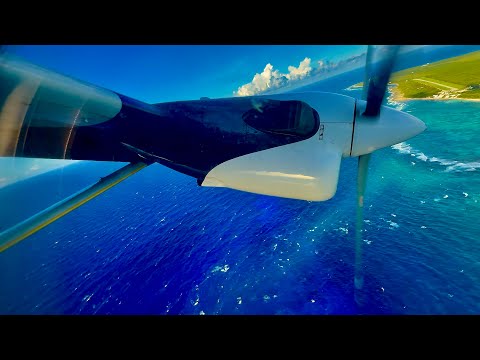
The De Havilland Canada DHC-6 Twin Otter is a fixed-gear, unpressurized twin turboprop that works from gravel, grass, water, snow, and ice where few other twins its size can operate. Certified in 1966 on two Pratt & Whitney Canada PT6A-27 turbines, it seats up to 19 and lifts a real payload out of runways around 1,500 ft. Bombardier, then Viking Air, then De Havilland Canada have kept the type certificate alive continuously, and the airplane is still built new today.
That continuity frames the central buyer decision. The classic Series 300 (1969-1988, roughly 614 built, 620 shp PT6A-27s) is the deep, well-supported used-market entry point; the current Series 400 from De Havilland Canada adds 750 shp PT6A-34s, a glass cockpit, and more useful load at new-airframe pricing. The specs here describe the -300. Whichever you choose, the mission is the same: rugged, low-and-slow access, not speed.
Key Features for GA Buyers
- STOL access is the whole point. Certified field lengths near 1,500 ft (SFAR-23, at max landing weight) open strips and clearings closed to most faster twins in its weight class.
- Configuration versatility. Quick-change wheels, floats, amphibious floats, and skis without structural modification. The float and amphib capability is what island, survey, and bush operators buy it for.
- Workhorse reliability and support. PT6A ubiquity, a global parts network, and continuous type-certificate stewardship give it high dispatch reliability and strong resale in utility markets.
Trade-offs
- Unpressurized, low and slow. The 25,000 ft ceiling is an oxygen-limited number, not a comfortable cruise; real missions run 5,000-10,000 ft at around 170 kt, with a full-fuel range near 800 nm. At that speed and altitude it is a utility hauler, not a fast cross-country machine.
- Turbine-twin operating cost. Two PT6A-27s put direct operating cost near $1,310/hr (about 74 gph of jet-A plus a two-engine overhaul reserve), below the pressurized Beechcraft 1900D commuter but far above any piston utility single.
- New versus used is a real fork. A -300 is the affordable, supported entry; a new -400 is a very different capital decision.
See Also
- Cessna 408 SkyCourier – a new-production twin-turboprop utility freighter and the closest -400 competitor. Compare
- Dornier 228 – a STOL twin-turboprop commuter in the same utility class. Compare
- Cessna 208 Caravan – the single-turbine utility hauler buyers cross-shop for lighter loads. Compare
Technical Specifications
Dimensions & Weights
- Height
- 20 ft
- Length
- 52 ft
- Parking area (ft²2)
- 4,260 ft²
- Max Takeoff Weight
- Source: FAA Type Certificate Data Sheet 12,500 lbs
- Max Landing Weight
- Source: FAA Type Certificate Data Sheet 12,300 lbs
- Useful Load
- Source: third-party reference 4,400 lbs
- Fuel Capacity
- Source: FAA Type Certificate Data Sheet 378 gal
Performance
- Cruise Speed
- Source: manufacturer figure 170 KTAS
- Never-Exceed (VNE)
- Source: FAA Type Certificate Data Sheet 160 KIAS
- Approach Speed
- 80 KIAS
- Stall, Clean (VS1)
- Source: third-party reference 56 KIAS
- Range
- Source: third-party reference 800 NM
- Service Ceiling
- Source: FAA Type Certificate Data Sheet 25,000 ft
- Rate of Climb
- 1600 fpm
- Takeoff over 50 ft obstacle
- 1,490 ft
- Landing over 50 ft obstacle
- 1,510 ft
Engines
Log in to view or request powerplant data.
Sources
Where the figures on this page come from. De Havilland Canada DHC-6 Twin Otter specifications are traced to published references; estimated values are flagged inline next to the figure.
-
FAA TCDS A9EA Rev 15, DHC-6-300 airspeed limits (CAS), landplane drs.faa.gov
-
De Havilland Canada Twin Otter Classic 300-G Wheels spec sheet dehavilland.com
-
-
Wikipedia DHC-6 Twin Otter en.wikipedia.org
Similar to the De Havilland Canada DHC-6 Twin Otter
Similar TurbopropsCessna 408 SkyCourier
Compare the De Havilland Canada DHC-6 Twin Otter to other aircraft
External Media


Articles and other links
-
-
-
Hangar Flight Museum: Historical Evolution of the DHC-6 thehangarmuseum.ca
-
Aerospace Global News: Marking the 1,000th Twin Otter Built aerospaceglobalnews.com
-
NOAA Aircraft Operations: Mission Profile of the DHC-6-300 www.omao.noaa.gov
-
Ownership Modeling: Operating Costs and Fixed Expenses for the DHC-6 www.aircraftcostcalculator.com